Sussex County Courthouse Historic District

Why it's listed
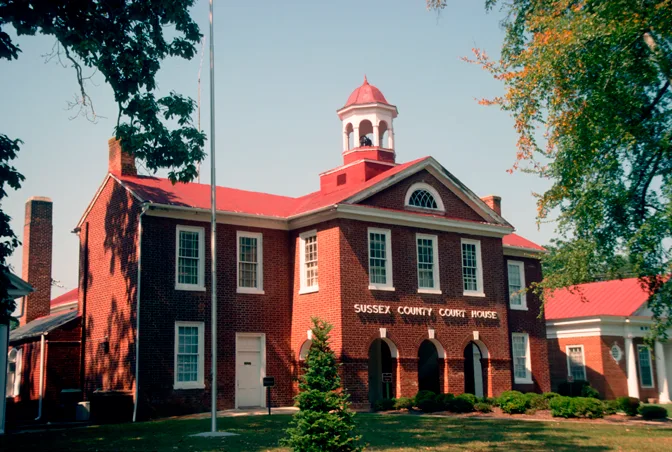
Sussex, Virginia, is a crossroads courthouse village organized around the Sussex County Court House, a two-story, seven-bay brick building completed in 1828 by Dabney Cosby, who also built Goochland Court House and worked as a mason at the University of Virginia. Its pedimented central pavilion opens into a ground-floor arcade of five rounded arches, and the Flemish bond walls have been painted since construction. A 1954 addition extends the original building. Nearby stand a 1924 clerk's office, a 1950s County Office Building, jail buildings, the circa 1800 Dillard House, a mid-nineteenth-century treasurer's office, and the Bannister House, once a girls' school. The courthouse reflects Jefferson's influence on Virginia public architecture through classical proportions and careful craftsmanship. The village, made up largely of buildings serving county government and shaded white frame houses, keeps the feel of a nineteenth-century court house community despite a few modern intrusions.
Machine-generated summary. This summary was generated by a language model from the official nomination document and has not been reviewed line by line by an editor. It may contain errors. Check the source document before relying on any detail. Source: nomination document (PDF) · catalog entry. Generated October 2026 (model claude-sonnet-5-5, prompt v1.0-2026-10-29).
| Period of significance | 19th Century |
|---|---|
| Styles | Jeffersonian classical influence (Roman-inspired, with arcaded ground floor) |
| Areas of significance | Politics/Government, Architecture |
| Acreage | 50 |
| Boundary source | NPS cultural-resource GIS polygon |
| Full listing page | Sussex County Courthouse Historic District (property record) |
What listing means for this property
This is a historic district. Buildings within its boundary are either contributing (they add to the district's significance) or non-contributing. Owners of contributing income-producing buildings can claim the 20% federal rehabilitation tax credit; homeowners should look at state credits. National Register districts impose no design review by themselves; a local historic district ordinance, if one exists, does (the difference explained).
General information, not legal or tax advice. Rules change; confirm with your State Historic Preservation Office or a qualified adviser.