St. John's Church Historic District (Boundary Increase)

Why it's listed
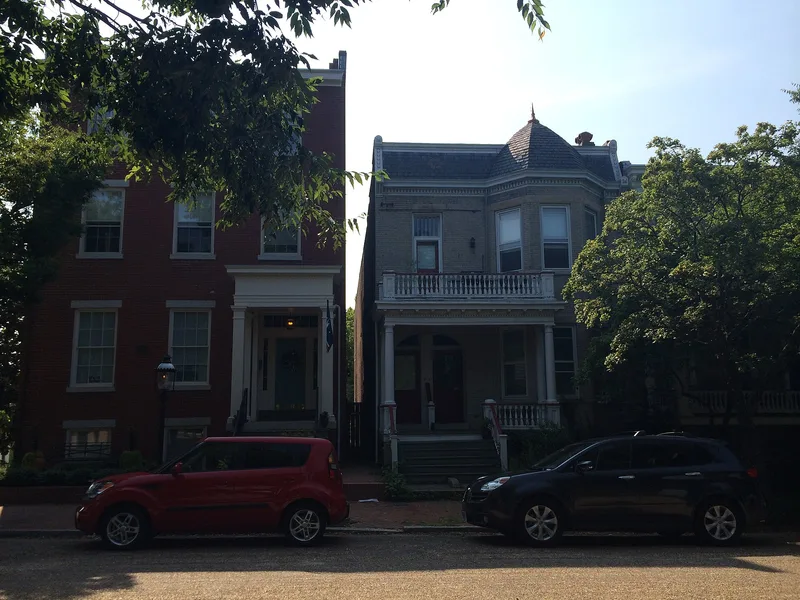
Church Hill in Richmond holds the city's largest concentration of antebellum houses, along with later residential, commercial and industrial buildings. This amendment extends the district to include the 2100 blocks of East Broad and East Grace streets, adding twenty buildings from 1855 to 1895. Among them are the Greek Revival Robert Alvis House of 1855, the Thomas W. Tignor House of 1856, an Italianate double house, and the 1874 Bellevue School, which lost its second story to a hurricane in 1950. The former Monte Maria Convent, built around an 1859 Italianate house, is also included. The amendment further describes 140 buildings from 1900 to 1920, mostly brick or frame houses with Queen Anne or Colonial Revival details. Other early twentieth-century examples are the 1921 Neoclassical Church Hill Bank, the Tudor Revival Bellevue School of 1912, St. Patrick's School, and several factories and warehouses. This documentation supports extending the district's period of significance into the early twentieth century.
Machine-generated summary. This summary was generated by a language model from the official nomination document and has not been reviewed line by line by an editor. It may contain errors. Check the source document before relying on any detail. Source: nomination document (PDF) · catalog entry. Generated October 2026 (model claude-sonnet-5-5, prompt v1.0-2026-10-29).
| Styles | Federal, Greek Revival, Victorian Italianate |
|---|---|
| Areas of significance | Architecture |
| Acreage | 7 |
| Boundary source | NPS cultural-resource GIS polygon |
| Full listing page | St. John's Church Historic District (Boundary Increase) (property record) |
What listing means for this property
This is a historic district. Buildings within its boundary are either contributing (they add to the district's significance) or non-contributing. Owners of contributing income-producing buildings can claim the 20% federal rehabilitation tax credit; homeowners should look at state credits. National Register districts impose no design review by themselves; a local historic district ordinance, if one exists, does (the difference explained).
General information, not legal or tax advice. Rules change; confirm with your State Historic Preservation Office or a qualified adviser.