Southwest Historic District

Why it's listed
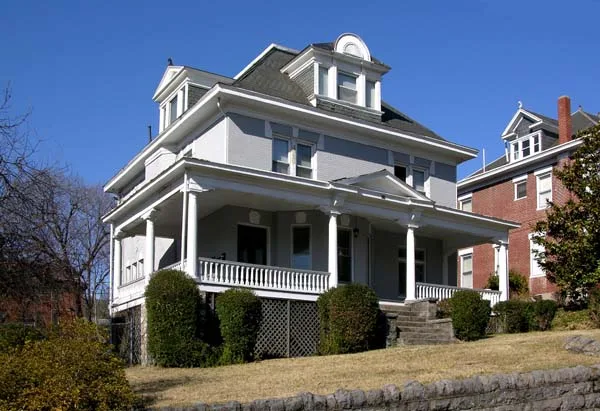
Covering roughly 105 blocks in the southwest quadrant of Roanoke, this district holds 1,658 structures, most of them houses built between 1882 and 1930. It includes three neighborhoods: Old Southwest, Mountain View and Hurt Park. Land companies, including the West End Land Company and a Norfolk and Western Railway subsidiary, laid out and promoted the area for railroad officials, businessmen and middle-income families. Most buildings date from 1900 to 1910, and the common type is a square frame or brick house with a tall hipped roof and a classical porch. Larger examples include Queen Anne residences on Campbell and Patterson avenues, three Shingle-style model homes on 2nd Street, and Colonial Revival mansions such as Mountain View, designed by H.H. Huggins. The district also contains Highland Park, churches, a synagogue, Highland Park School and the Tudor Revival Jefferson High School. It is considered significant for the cohesion and integrity of this early 20th-century streetscape, with few intrusions.
Machine-generated summary. This summary was generated by a language model from the official nomination document and has not been reviewed line by line by an editor. It may contain errors. Check the source document before relying on any detail. Source: nomination document (PDF) · catalog entry. Generated October 2026 (model claude-sonnet-5-5, prompt v1.0-2026-10-29).
| Styles | Queen Anne, Shingle, Colonial Revival, Bungalow, American Foursquare, Tudor Revival |
|---|---|
| Areas of significance | Community Planning and Development, Transportation, Architecture |
| Acreage | 375 |
| Boundary source | NPS cultural-resource GIS polygon |
| Full listing page | Southwest Historic District (property record) |
What listing means for this property
This is a historic district. Buildings within its boundary are either contributing (they add to the district's significance) or non-contributing. Owners of contributing income-producing buildings can claim the 20% federal rehabilitation tax credit; homeowners should look at state credits. National Register districts impose no design review by themselves; a local historic district ordinance, if one exists, does (the difference explained).
General information, not legal or tax advice. Rules change; confirm with your State Historic Preservation Office or a qualified adviser.