South Boston Historic District

Why it's listed
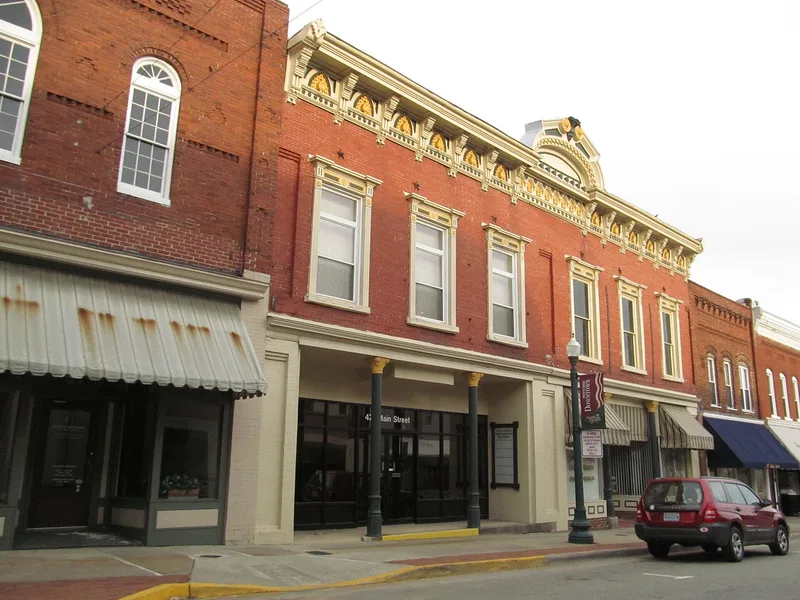
South Boston's historic district takes in much of the city along the Dan River and the railway. Its southwestern part holds brick tobacco warehouses and prizeries, a railroad depot, the 1897 Century Cotton Mill (later Halifax Cotton Mill) and forty-eight company houses built around 1900 on a hill above it. Downtown, the 100-400 blocks of South Main Street and nearby streets are lined with mostly two-story brick commercial buildings, including the 1888 E.L. Evans Building, the 1891 Planters and Merchants Bank, the circa 1910 Municipal Building with its arcaded belfry, and the 1918 Neoclassical bank at Ferry Street and Wilborn Avenue. North and east of downtown lies a residential area, with Italianate and Queen Anne houses along North Main Street and Washington Avenue, plus many vernacular houses. Churches and a 1909 hospital are also included. The district contains 432 contributing buildings, 3 contributing structures and 72 noncontributing buildings.
Machine-generated summary. This summary was generated by a language model from the official nomination document and has not been reviewed line by line by an editor. It may contain errors. Check the source document before relying on any detail. Source: nomination document (PDF) · catalog entry. Generated October 2026 (model claude-sonnet-5-5, prompt v1.0-2026-10-29).
| Styles | Mixed: Victorian Italianate, Queen Anne, Colonial Revival, Neoclassical, Gothic Revival, Bungalow, American Foursquare, Tudor Revival, Spanish Colonial Revival and local vernacular types |
|---|---|
| Areas of significance | Industry, Commerce, Transportation, Architecture |
| Acreage | 262 |
| Boundary source | NPS cultural-resource GIS polygon |
| Full listing page | South Boston Historic District (property record) |
What listing means for this property
This is a historic district. Buildings within its boundary are either contributing (they add to the district's significance) or non-contributing. Owners of contributing income-producing buildings can claim the 20% federal rehabilitation tax credit; homeowners should look at state credits. National Register districts impose no design review by themselves; a local historic district ordinance, if one exists, does (the difference explained).
General information, not legal or tax advice. Rules change; confirm with your State Historic Preservation Office or a qualified adviser.