Snake Creek Farm Historic District

The National Park Service has not published a boundary polygon for this district; the map shows the listed properties inside it and the district's reference point.
Why it's listed
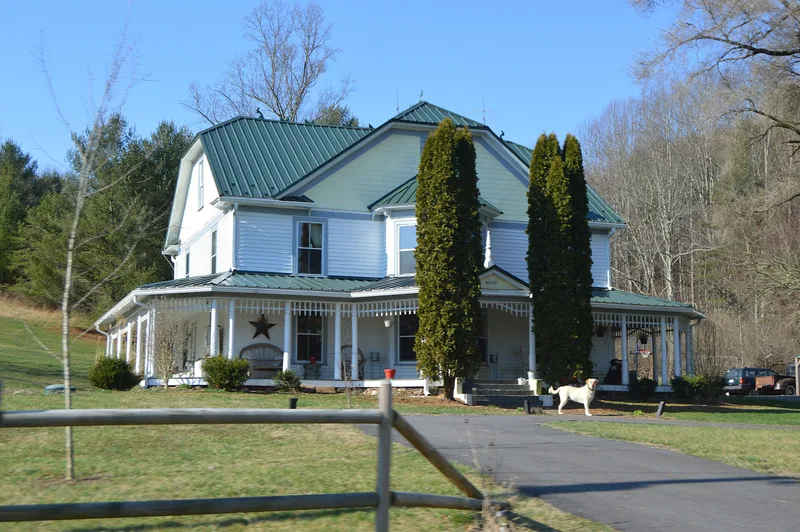
Snake Creek Farm is a small farm complex in a remote valley of northern Carroll County, Virginia, north of the crest of the Blue Ridge. Its centerpiece is a two-and-one-half-story frame house built by farmer James F. Martin soon after he bought the land in 1910. It has a double-pile, center-passage plan, a clipped gable roof with metal shingles in the gables, decorative metal cresting, and finished rooms on the third floor. Interior walls are sheathed in tongue-and-groove boards, a practice tied to a local shortage of plaster. Nearby are a springhouse, a meathouse, a family cemetery with early to mid-nineteenth-century graves, and a two-room schoolhouse that Martin had built in 1907. The school served neighborhood children until the 1950s, and Martin's second wife, Nettie, taught there. The house is considered a rarity in southwest Virginia, and the school reflects the public education system established after the Civil War.
Machine-generated summary. This summary was generated by a language model from the official nomination document and has not been reviewed line by line by an editor. It may contain errors. Check the source document before relying on any detail. Source: nomination document (PDF) · catalog entry. Generated October 2026 (model claude-sonnet-5-5, prompt v1.0-2026-10-29).
| Period of significance | 1907-1915 |
|---|---|
| Styles | Double-pile center-passage plan (Georgian plan) |
| Areas of significance | Architecture |
| Acreage | 9.5 |
| Boundary source | not published |
| Full listing page | Snake Creek Farm Historic District (property record) |
What listing means for this property
This is a historic district. Buildings within its boundary are either contributing (they add to the district's significance) or non-contributing. Owners of contributing income-producing buildings can claim the 20% federal rehabilitation tax credit; homeowners should look at state credits. National Register districts impose no design review by themselves; a local historic district ordinance, if one exists, does (the difference explained).
General information, not legal or tax advice. Rules change; confirm with your State Historic Preservation Office or a qualified adviser.