Poplar Forest (Additional Documentation)

Why it's listed
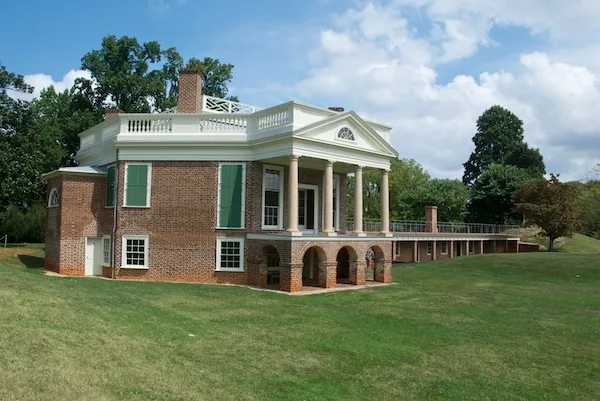
Poplar Forest is a brick, one-story, octagonal house on a high basement in Bedford County, near Lynchburg, Virginia. Thomas Jefferson designed it as a rural retreat from the social pressures of Monticello, and construction ran from 1806 to 1819. He visited several times a year, often staying about a month. Inside, four elongated octagonal rooms surround a square central hall that was once lit from above. Tuscan porticoes mark the entrance and rear fronts, and two octagonal privies are hidden by artificial mounds in the grounds. A kitchen and smokehouse still stand, though the office wing has left no trace above ground. A fire in 1845 gutted the house. Repairs followed at once, but the original decoration was not restored, and the skylight and balustrade were omitted. The nomination ranks it among Jefferson's most important designs while acknowledging that the fire and rebuilding reduced its standing.
Machine-generated summary. This summary was generated by a language model from the official nomination document and has not been reviewed line by line by an editor. It may contain errors. Check the source document before relying on any detail. Source: nomination document (PDF) · catalog entry. Generated October 2026 (model claude-sonnet-5-5, prompt v1.0-2026-10-29).
| Period of significance | 19th Century |
|---|---|
| Areas of significance | Architecture, Agriculture, Ethnic Heritage-Black, Landscape Architecture, Politics/Government, Archeology-Historic Non-Aboriginal |
| Acreage | 800 |
| Boundary source | NPS cultural-resource GIS polygon |
| Full listing page | Poplar Forest (Additional Documentation) (property record) |
What listing means for this property
This is a historic district. Buildings within its boundary are either contributing (they add to the district's significance) or non-contributing. Owners of contributing income-producing buildings can claim the 20% federal rehabilitation tax credit; homeowners should look at state credits. National Register districts impose no design review by themselves; a local historic district ordinance, if one exists, does (the difference explained).
General information, not legal or tax advice. Rules change; confirm with your State Historic Preservation Office or a qualified adviser.