Norfolk and Western Railway Company Historic District

The National Park Service has not published a boundary polygon for this district; the map shows the listed properties inside it and the district's reference point.
Why it's listed
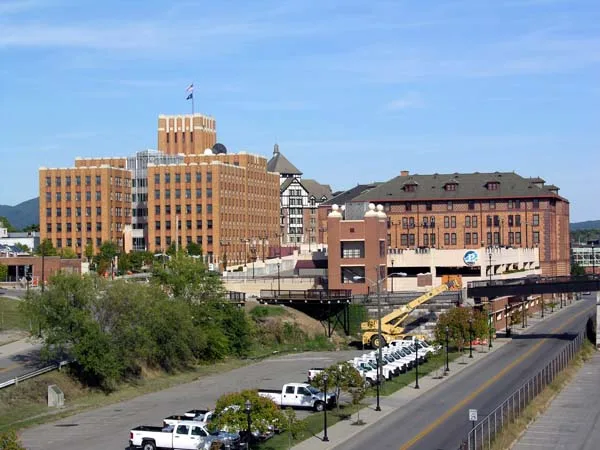
Three railroad buildings in downtown Roanoke, Virginia, form a district tied to the Norfolk & Western Railway, the company whose arrival in the 1880s shaped the city's growth. The six-story General Office Building-South, begun in 1896 and extended in 1903 and 1907, is a Neoclassical Revival design in yellow and brown brick with a slate roof. The eight-story General Office Building-North, finished in 1931 to designs by Paul Hayes, is an Art Deco tower with vertical brick pilasters, precast stone and aluminum detailing. The Passenger Station combines a symmetrical Neoclassical Revival structure with Moderne styling by industrial designer Raymond Loewy, who added an entrance portico in 1949. The district is significant for its role in transportation and commerce and for the quality of its architecture. Exteriors remain largely intact, while interiors have been altered by partitions and dropped ceilings but keep many original features.
Machine-generated summary. This summary was generated by a language model from the official nomination document and has not been reviewed line by line by an editor. It may contain errors. Check the source document before relying on any detail. Source: nomination document (PDF) · catalog entry. Generated October 2026 (model claude-sonnet-5-5, prompt v1.0-2026-10-29).
| Period of significance | 1896-1949 |
|---|---|
| Styles | Neoclassical Revival (88 Jefferson St. N.W.); Art Deco (108 Jefferson St. N.W.); Neoclassical Revival/Moderne (209 Shenandoah Ave.) |
| Areas of significance | Architecture, Commerce, Transportation |
| Acreage | 4.9 |
| Boundary source | not published |
| Full listing page | Norfolk and Western Railway Company Historic District (property record) |
What listing means for this property
This is a historic district. Buildings within its boundary are either contributing (they add to the district's significance) or non-contributing. Owners of contributing income-producing buildings can claim the 20% federal rehabilitation tax credit; homeowners should look at state credits. National Register districts impose no design review by themselves; a local historic district ordinance, if one exists, does (the difference explained).
General information, not legal or tax advice. Rules change; confirm with your State Historic Preservation Office or a qualified adviser.