Green Hill

Why it's listed
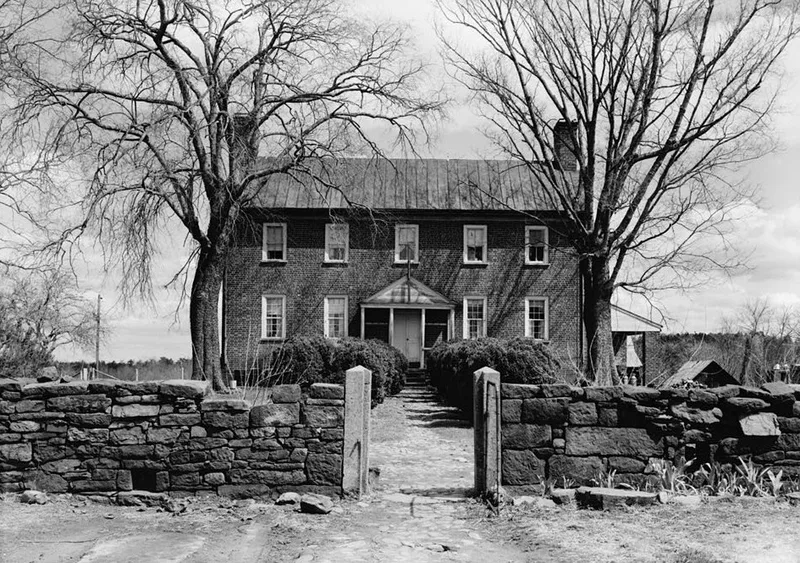
Green Hill is a plantation complex in Campbell County, Virginia, north of the Staunton River and southwest of Long Island. The main house is a two-story, five-bay Flemish bond brick building with a gable roof, modillioned cornice and two interior end chimneys. A one-story rear ell was probably built about 1800, and the front section was added soon after by Samuel Pannill, who bought the original land in 1797. Pannill served in the Virginia General Assembly, sat on the Board of Public Works and was president of the Roanoke Navigation Company. Inside, the house has notable woodwork, including a paneled chimney wall, a provincial entablature with reeding and scalloping, and a large mantel in the ell. Many outbuildings survive, among them a frame kitchen with an eighteen-foot stone chimney, a stone laundry, slave quarters, log barns, an ice house, a tobacco barn and a granary, linked by wide stone walkways. The variety of surviving farm buildings is the main reason for its listing.
Machine-generated summary. This summary was generated by a language model from the official nomination document and has not been reviewed line by line by an editor. It may contain errors. Check the source document before relying on any detail. Source: nomination document (PDF) · catalog entry. Generated October 2026 (model claude-sonnet-5-5, prompt v1.0-2026-10-29).
| Period of significance | 19th Century |
|---|---|
| Areas of significance | Architecture, Agriculture |
| Boundary source | NPS cultural-resource GIS polygon |
| Full listing page | Green Hill (property record) |
What listing means for this property
This is a historic district. Buildings within its boundary are either contributing (they add to the district's significance) or non-contributing. Owners of contributing income-producing buildings can claim the 20% federal rehabilitation tax credit; homeowners should look at state credits. National Register districts impose no design review by themselves; a local historic district ordinance, if one exists, does (the difference explained).
General information, not legal or tax advice. Rules change; confirm with your State Historic Preservation Office or a qualified adviser.