Fluvanna County Courthouse Historic District

Why it's listed
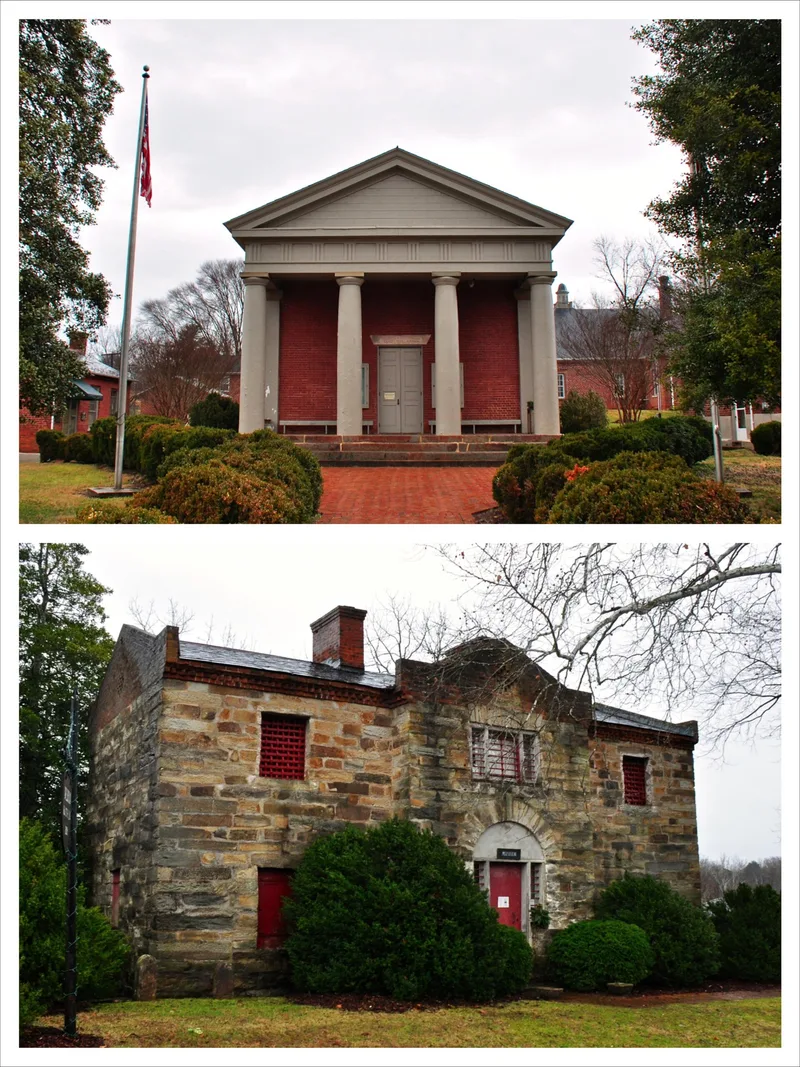
Palmyra's court complex sits on a steep knoll above the Rivanna River, overlooking a small square with a Confederate soldiers' monument. Its centerpiece is the Fluvanna County court house, finished in 1831 as a tetrastyle Roman Doric temple of Flemish-bond brick, stucco columns and stone trim. Inside, the heavy balustrades around the judge's bench, jury box and clerk's desk survive, along with staircases that double as witness stands; only the original seating has been lost. Nearby are a small lawyer's office with a Palladian arch gable and a stone jail of 1829, now the county museum, built by stonemason John G. Hughes in a style close to farm buildings he raised at Bremo. Palmyra became the county seat after two referenda in 1828. General John Hartwell Cocke served on the commission that drafted the plans, and tradition credits him with the court house design. The group is valued as an unspoiled early Virginia county-seat setting.
Machine-generated summary. This summary was generated by a language model from the official nomination document and has not been reviewed line by line by an editor. It may contain errors. Check the source document before relying on any detail. Source: nomination document (PDF) · catalog entry. Generated October 2026 (model claude-sonnet-5-5, prompt v1.0-2026-10-29).
| Styles | Roman Doric temple form (Greek Revival-era court house) |
|---|---|
| Areas of significance | Community Planning and Development, Architecture |
| Acreage | 60 |
| Boundary source | NPS cultural-resource GIS polygon |
| Full listing page | Fluvanna County Courthouse Historic District (property record) |
What listing means for this property
This is a historic district. Buildings within its boundary are either contributing (they add to the district's significance) or non-contributing. Owners of contributing income-producing buildings can claim the 20% federal rehabilitation tax credit; homeowners should look at state credits. National Register districts impose no design review by themselves; a local historic district ordinance, if one exists, does (the difference explained).
General information, not legal or tax advice. Rules change; confirm with your State Historic Preservation Office or a qualified adviser.