Court House Hill-Downtown

The National Park Service has not published a boundary polygon for this district; the map shows the listed properties inside it and the district's reference point.
Why it's listed
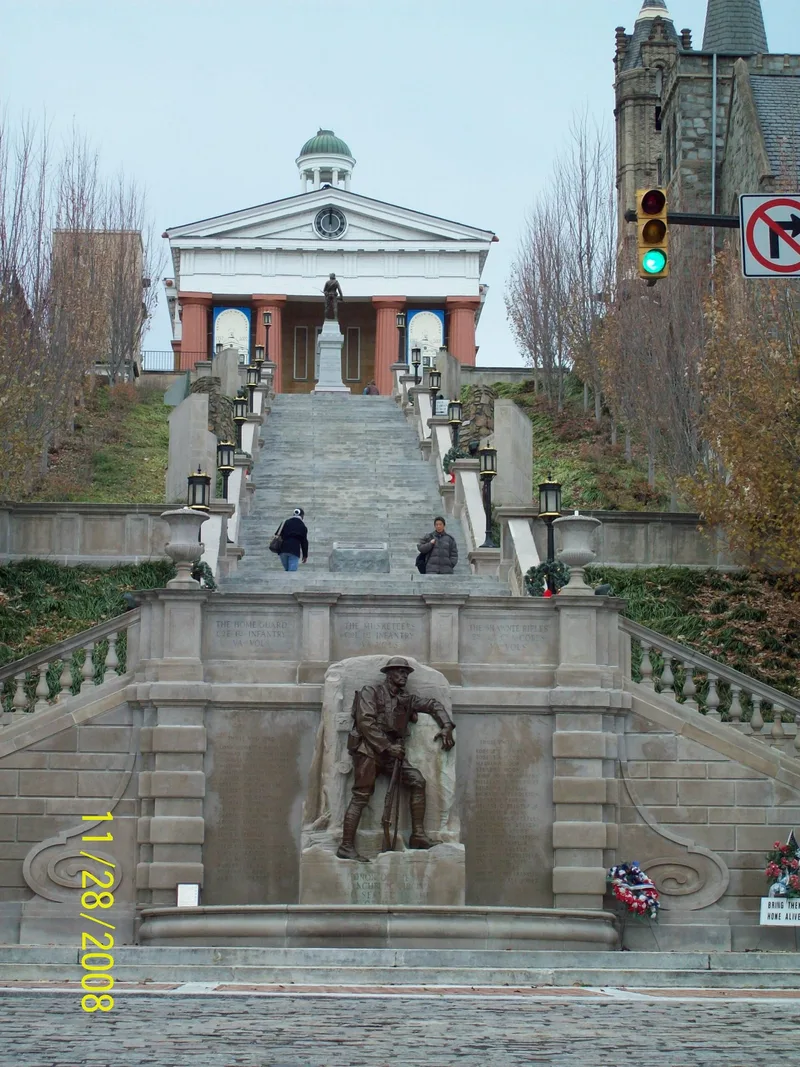
Downtown Lynchburg's Court House Hill district covers 25 blocks on a promontory above the James River's Lower Basin. It spans 47 acres and includes commercial, residential, religious and governmental buildings. The upper section, Courthouse Hill, takes its name from the 1851 Greek Revival courthouse overlooking Monument Terrace. Below it, Church and Main Streets hold commercial buildings, civic buildings and banks. About 70 percent of the district's buildings date from the period between 1865 and 1914, when the city grew rapidly. Notable examples include the 1909-10 City Auditorium and Market, the 1931-32 Armory, the 1883-85 Clay Street Reservoir, a ten-story bank tower finished in 1914, and several Gothic and Romanesque Revival churches. Local architects such as August Forsberg and Edward Frye shaped much of the streetscape. Of the resources counted, 88 percent are historic, and most upper facades remain intact even where storefronts have changed. The district was listed for its role in the city's development and its architecture.
Machine-generated summary. This summary was generated by a language model from the official nomination document and has not been reviewed line by line by an editor. It may contain errors. Check the source document before relying on any detail. Source: nomination document (PDF) · catalog entry. Generated October 2026 (model claude-sonnet-5-5, prompt v1.0-2026-10-29).
| Styles | Early Classical Revival; Federal; Romanesque Revival; Italian Villa; High Victorian Revival; Second Empire; Queen Anne; Renaissance Beaux Arts; Classical Revival; Spanish Colonial Revival; Commercial Style; Moderne; Art Deco |
|---|---|
| Areas of significance | Architecture, Commerce, Industry, Politics/Government, Religion |
| Acreage | 47.29 |
| Boundary source | not published |
| Full listing page | Court House Hill-Downtown (property record) |
What listing means for this property
This is a historic district. Buildings within its boundary are either contributing (they add to the district's significance) or non-contributing. Owners of contributing income-producing buildings can claim the 20% federal rehabilitation tax credit; homeowners should look at state credits. National Register districts impose no design review by themselves; a local historic district ordinance, if one exists, does (the difference explained).
General information, not legal or tax advice. Rules change; confirm with your State Historic Preservation Office or a qualified adviser.