Commonwealth Club Historic District

The National Park Service has not published a boundary polygon for this district; the map shows the listed properties inside it and the district's reference point.
Why it's listed
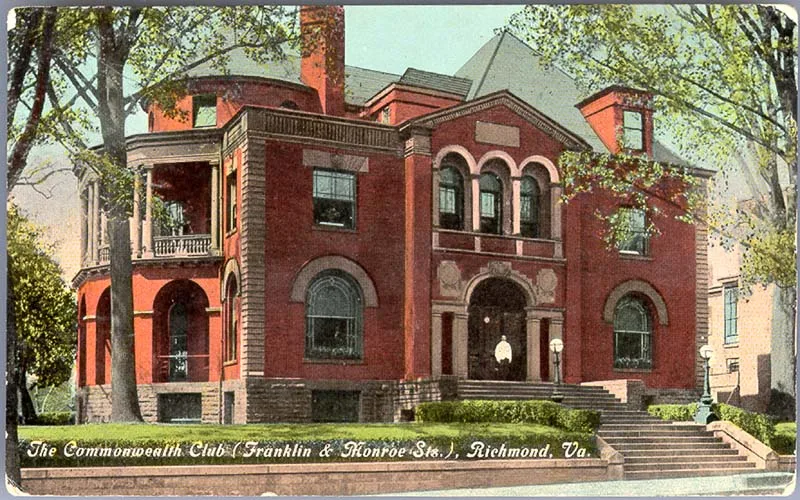
Franklin Street was laid out in the early 19th century as a desirable address for well-to-do Richmonders, and the 400 block of West Franklin took its present form in the 1880s and 1890s. This district preserves a row of three-story townhouses in brick, brownstone, granite and terra cotta, each built by an individual family rather than as a development. Styles range from Italianate to Romanesque, Colonial Revival and Classical, yet matching cornice heights and materials give the block visual unity. Its focal point is the Commonwealth Club, designed by Carrere & Hastings of New York and occupied in 1892, the first Richmond club housed in a building made for the purpose. Modern high-rise apartments and hotels built in the 1960s and 1970s now surround the block, which survives as a reminder of the street's era as the city's most fashionable residential address. The district includes fourteen buildings, none of them non-contributing.
Machine-generated summary. This summary was generated by a language model from the official nomination document and has not been reviewed line by line by an editor. It may contain errors. Check the source document before relying on any detail. Source: nomination document (PDF) · catalog entry. Generated October 2026 (model claude-sonnet-5-5, prompt v1.0-2026-10-29).
| Period of significance | 1800-1899 and 1900- (checked on the form; no specific dates given) |
|---|---|
| Styles | Italianate, Romanesque, Colonial Revival, Classical, Renaissance Revival, modified Gothic |
| Areas of significance | Community Planning and Development, Architecture, Social History |
| Acreage | 3 |
| Boundary source | not published |
| Full listing page | Commonwealth Club Historic District (property record) |
What listing means for this property
This is a historic district. Buildings within its boundary are either contributing (they add to the district's significance) or non-contributing. Owners of contributing income-producing buildings can claim the 20% federal rehabilitation tax credit; homeowners should look at state credits. National Register districts impose no design review by themselves; a local historic district ordinance, if one exists, does (the difference explained).
General information, not legal or tax advice. Rules change; confirm with your State Historic Preservation Office or a qualified adviser.