Buckingham Historic District Boundary Increase

Why it's listed
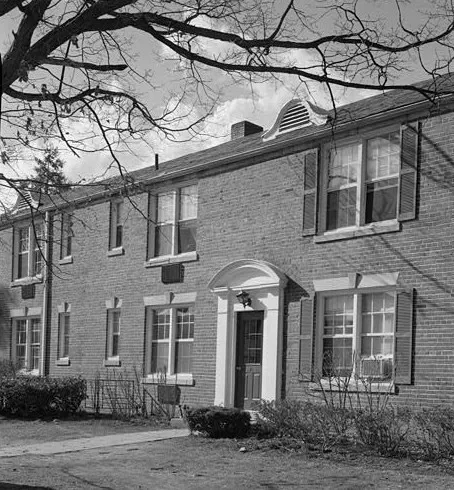
Sixteen two-story brick apartment buildings in Arlington County, Virginia, make up Buckingham Village 3, an addition to the Buckingham Historic District. Bounded by North Pershing Drive, North George Mason Drive, 4th Street North and North Thomas Street, the buildings were erected around 1939 and in 1940 as part of the third and fifth phases of the larger Buckingham complex. Architects Allan F. Kamstra and Albert Leuders carried forward the plan set by Henry Wright after his death, and the Geran Construction Company built them. The Colonial Revival buildings have six-course American-bond brick walls, hipped roofs that are mostly slate, cast stone sill courses and wood entry surrounds with pediments. They are arranged around U-shaped and H-shaped courtyards with mature trees and walking paths, leaving most of the land open. They are listed for their architecture and for their role in the community planning and landscape design of a garden-apartment development. The buildings remain in apartment use today.
Machine-generated summary. This summary was generated by a language model from the official nomination document and has not been reviewed line by line by an editor. It may contain errors. Check the source document before relying on any detail. Source: nomination document (PDF) · catalog entry. Generated October 2026 (model claude-sonnet-5-5, prompt v1.0-2026-10-29).
| Period of significance | 1937-1953 |
|---|---|
| Styles | Late 19th and 20th Century Revivals/Colonial Revival |
| Areas of significance | Architecture, Community Planning and Development, Landscape Architecture |
| Acreage | 6.1 |
| Boundary source | NPS cultural-resource GIS polygon |
| Full listing page | Buckingham Historic District Boundary Increase (property record) |
What listing means for this property
This is a historic district. Buildings within its boundary are either contributing (they add to the district's significance) or non-contributing. Owners of contributing income-producing buildings can claim the 20% federal rehabilitation tax credit; homeowners should look at state credits. National Register districts impose no design review by themselves; a local historic district ordinance, if one exists, does (the difference explained).
General information, not legal or tax advice. Rules change; confirm with your State Historic Preservation Office or a qualified adviser.