200 Block West Franklin Street Historic District (Boundary Increase)

The National Park Service has not published a boundary polygon for this district; the map shows the listed properties inside it and the district's reference point.
Why it's listed
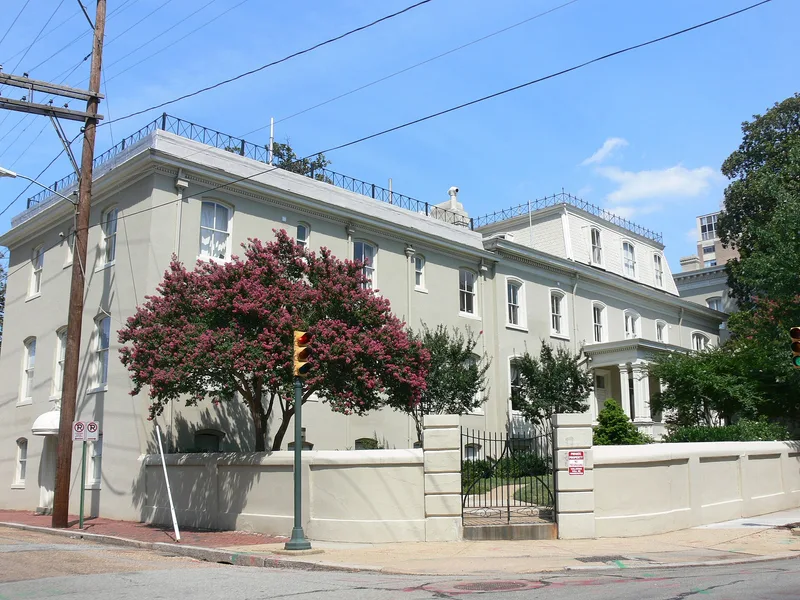
Queen Anne Row is a group of five two-story rowhouses at 212-220 West Main Street in Richmond, built in 1891 on land owned by J. Cabell Brokenbrough as middle-class rental housing. The houses share common walls and have small rear courtyards. Their fronts combine seven contrasting colors of brick, granite, limestone and brownstone, and no two are alike. Turrets with patterned metal roofs, varied bay windows, colored glass and decorated entry porches break up the facade. Inside, the houses share a side-hall plan with two equal rooms joined by double doors, and most original mantels, doors and windows survive. Separate rear entrances allowed each to serve as a duplex or a single-family home. The row was left out of the 200 Block West Franklin Street Historic District when it was listed in 1977, although it is of similar construction and period and is linked to the block by a cobblestone alley. The houses became vacant in the 1980s and were being renovated for residential use.
Machine-generated summary. This summary was generated by a language model from the official nomination document and has not been reviewed line by line by an editor. It may contain errors. Check the source document before relying on any detail. Source: nomination document (PDF) · catalog entry. Generated October 2026 (model claude-sonnet-5-5, prompt v1.0-2026-10-29).
| Period of significance | 1800-1916 |
|---|---|
| Styles | Late Victorian: Queen Anne |
| Areas of significance | Architecture |
| Acreage | 0.9 |
| Boundary source | not published |
| Full listing page | 200 Block West Franklin Street Historic District (Boundary Increase) (property record) |
What listing means for this property
This is a historic district. Buildings within its boundary are either contributing (they add to the district's significance) or non-contributing. Owners of contributing income-producing buildings can claim the 20% federal rehabilitation tax credit; homeowners should look at state credits. National Register districts impose no design review by themselves; a local historic district ordinance, if one exists, does (the difference explained).
General information, not legal or tax advice. Rules change; confirm with your State Historic Preservation Office or a qualified adviser.