Swiss Avenue Historic District

Why it's listed
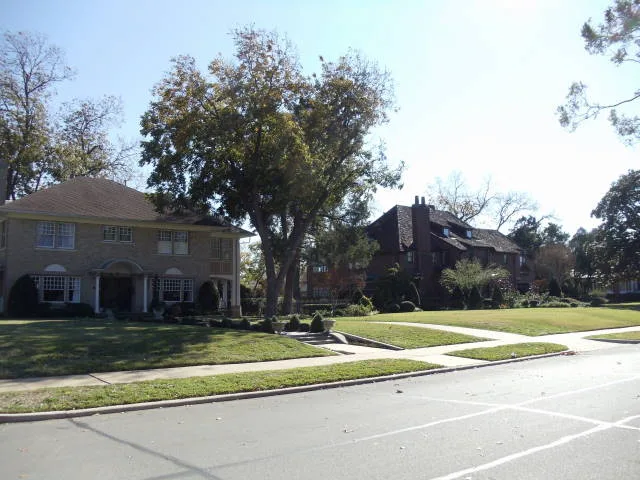
Swiss Avenue in Dallas is a tree-lined boulevard with a landscaped parkway, running between Fitzhugh and La Vista. It was the centerpiece of Munger Place, a 140-acre subdivision announced in 1905 by cotton gin manufacturer R. S. Munger and meant to be an exclusive residential district. The first house, built that year at 5303 Swiss by Dr. R. W. Baird, was a Classical Revival mansion; most of roughly 200 homes followed in the 1910s and 1920s. Sixteen or more styles appear, among them Georgian Revival, Jacobethan, Queen Anne, Italian villa and Prairie-influenced designs. Brick construction, equal setbacks and common height give the street its unity. Deed restrictions set cost minimums, two-story height and deep setbacks, and are described as the first restricted development in Texas. Early residents included bankers, merchants, physicians and a former mayor. The avenue is the only part of Munger Place that kept its neighborhood character, and the city adopted a historic zoning ordinance for it. A relocated 1884 Victorian house was later added as a contributing element.
Machine-generated summary. This summary was generated by a language model from the official nomination document and has not been reviewed line by line by an editor. It may contain errors. Check the source document before relying on any detail. Source: nomination document (PDF) · catalog entry. Generated October 2026 (model claude-sonnet-5-5, prompt v1.0-2026-10-29).
| Period of significance | 20th Century (specific date 1905) |
|---|---|
| Styles | Variety of early 20th century styles (at least sixteen), including Classical Revival, Jacobethan/Tudor, Georgian Revival, Prairie, Queen Anne, Italian villa and Spanish Renaissance |
| Areas of significance | Community Planning and Development, Landscape Architecture, Architecture |
| Acreage | 57.1 |
| Boundary source | NPS cultural-resource GIS polygon |
| Full listing page | Swiss Avenue Historic District (property record) |
What listing means for this property
This is a historic district. Buildings within its boundary are either contributing (they add to the district's significance) or non-contributing. Owners of contributing income-producing buildings can claim the 20% federal rehabilitation tax credit; homeowners should look at state credits. National Register districts impose no design review by themselves; a local historic district ordinance, if one exists, does (the difference explained).
General information, not legal or tax advice. Rules change; confirm with your State Historic Preservation Office or a qualified adviser.