Paris Commercial Historic District

Why it's listed
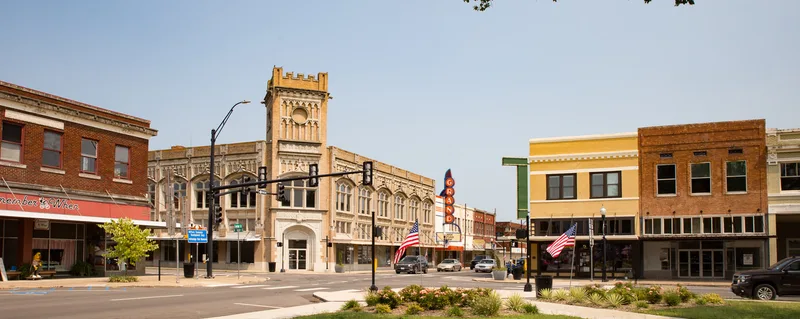
Downtown Paris, Texas, is preserved as a 28-block district of roughly 150 buildings arranged in a grid around the Plaza, the site of founder George Wright's early store. Fires in 1877 and 1916 destroyed earlier commercial structures, so most buildings date from a rebuilding boom between 1916 and 1920. Local architects and investors drew on Midwestern trends from St. Louis, Chicago and Kansas City, producing one- and two-story masonry buildings with Prairie School detailing alongside Beaux Arts public buildings. Notable works include the Lamar County Courthouse, City Hall and Fire Station, the Paris Public Library, the Culbertson Fountain and the Peristyle in Bywaters Park, several designed by J.L. Wees. The district also reflects unusual planning: the courthouse was moved off the square in 1873, and a park and market square were created south of the Plaza after 1916. The result is a visually harmonious commercial center tied to the cotton economy of northeast Texas.
Machine-generated summary. This summary was generated by a language model from the official nomination document and has not been reviewed line by line by an editor. It may contain errors. Check the source document before relying on any detail. Source: nomination document (PDF) · catalog entry. Generated October 2026 (model claude-sonnet-5-5, prompt v1.0-2026-10-29).
| Period of significance | 1895-1936 |
|---|---|
| Styles | Early 20th-century commercial styles, including Prairie School, Beaux Arts, Classical Revival, Spanish Colonial Revival and Gothic Revival |
| Areas of significance | Community Planning and Development, Commerce, Architecture |
| Acreage | 60 |
| Boundary source | NPS cultural-resource GIS polygon |
| Full listing page | Paris Commercial Historic District (property record) |
What listing means for this property
This is a historic district. Buildings within its boundary are either contributing (they add to the district's significance) or non-contributing. Owners of contributing income-producing buildings can claim the 20% federal rehabilitation tax credit; homeowners should look at state credits. National Register districts impose no design review by themselves; a local historic district ordinance, if one exists, does (the difference explained).
General information, not legal or tax advice. Rules change; confirm with your State Historic Preservation Office or a qualified adviser.