Matagorda Cemetery

The National Park Service has not published a boundary polygon for this district; the map shows the listed properties inside it and the district's reference point.
Why it's listed
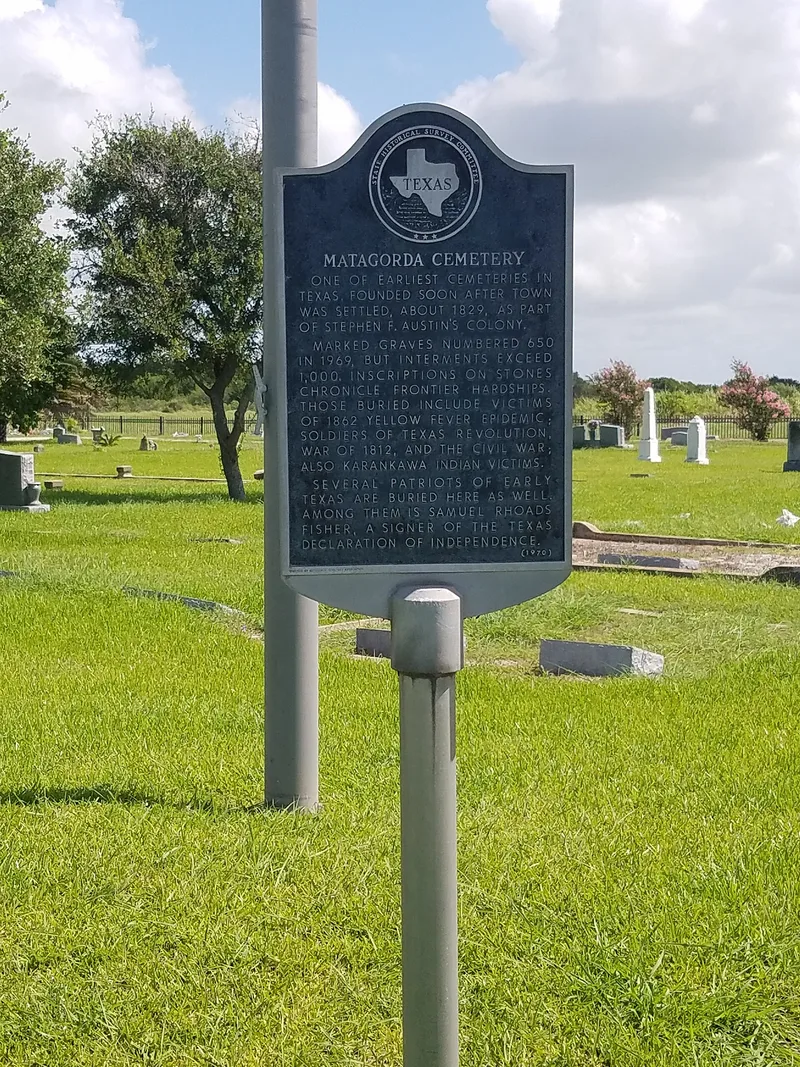
Matagorda Cemetery occupies 7.29 acres of flat Gulf Coast prairie at the northeast edge of the town of Matagorda, Texas. The first known burials, in 1830, were Esther Randall Wightman and her husband Benjamin, parents of town founder Elias R. Wightman. The town proprietors formally set the ground aside as a public cemetery in 1833. Today it holds more than 1,255 known graves, and an estimated 350 more may be unmarked. Shell-paved drives divide it into sections A through E; section A was reserved for African American and Hispanic residents. Markers include marble tablets, Victorian tabernacle monuments, obelisks, crypts, folk-made pieces and four 1936 Texas Centennial markers. Storms, especially the 1942 hurricane, destroyed much of the town, leaving the cemetery as its best-preserved historic resource. Its graves include veterans of several wars, victims of epidemics, and figures from the Republic of Texas. The period of significance ends in 1955.
Machine-generated summary. This summary was generated by a language model from the official nomination document and has not been reviewed line by line by an editor. It may contain errors. Check the source document before relying on any detail. Source: nomination document (PDF) · catalog entry. Generated October 2026 (model claude-sonnet-5-5, prompt v1.0-2026-10-29).
| Period of significance | 1830-1955 |
|---|---|
| Areas of significance | Exploration/Settlement, Community Planning and Development |
| Acreage | 7.3 |
| Boundary source | not published |
| Full listing page | Matagorda Cemetery (property record) |
What listing means for this property
This is a historic district. Buildings within its boundary are either contributing (they add to the district's significance) or non-contributing. Owners of contributing income-producing buildings can claim the 20% federal rehabilitation tax credit; homeowners should look at state credits. National Register districts impose no design review by themselves; a local historic district ordinance, if one exists, does (the difference explained).
General information, not legal or tax advice. Rules change; confirm with your State Historic Preservation Office or a qualified adviser.