Allen Water Station

The National Park Service has not published a boundary polygon for this district; the map shows the listed properties inside it and the district's reference point.
Why it's listed
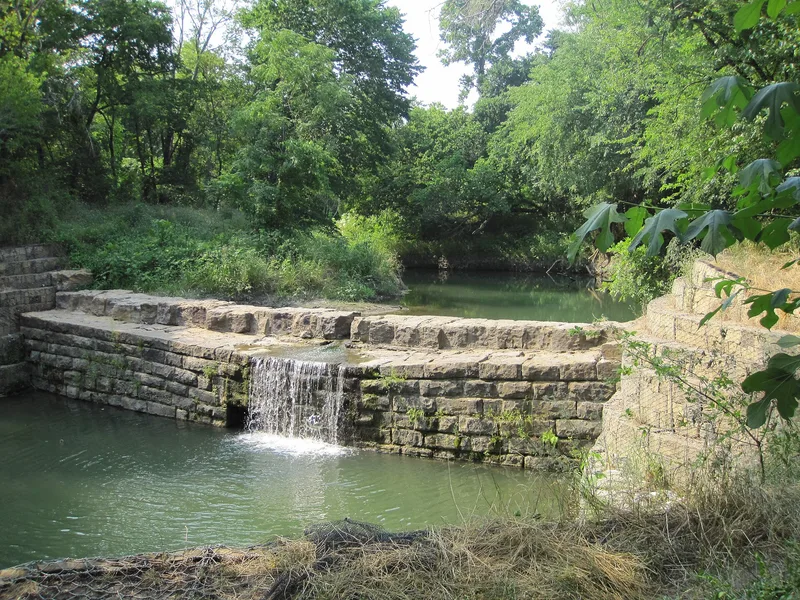
Allen Water Station is a small railroad heritage district along Cottonwood Creek in Allen, Texas, now part of the city park system. The Houston & Texas Central Railway began the station in 1874 to refill steam locomotives on its line between Dallas and Denison. The most visible feature is a stone overfall dam, about 69 feet long in its central section, which created the water supply. Nearby are twelve stone piers that once supported a circular wooden water tank, the brick and concrete remains of a pumping facility, the railroad bed, and a steel plate girder bridge dated 1910. Southern Pacific expanded the system around 1912 with a larger concrete dam downstream, which was later breached and demolished, allowing the older stone dam to function again. The station was built at a remote spot before the town of Allen was platted in 1876. The surviving ruins and archaeological remains preserve evidence of how a rural railroad water station was arranged and operated.
Machine-generated summary. This summary was generated by a language model from the official nomination document and has not been reviewed line by line by an editor. It may contain errors. Check the source document before relying on any detail. Source: nomination document (PDF) · catalog entry. Generated October 2026 (model claude-sonnet-5-5, prompt v1.0-2026-10-29).
| Styles | Other: dam, bridge |
|---|---|
| Areas of significance | Transportation, Exploration/Settlement |
| Acreage | 5.7 |
| Boundary source | not published |
| Full listing page | Allen Water Station (property record) |
What listing means for this property
This is a historic district. Buildings within its boundary are either contributing (they add to the district's significance) or non-contributing. Owners of contributing income-producing buildings can claim the 20% federal rehabilitation tax credit; homeowners should look at state credits. National Register districts impose no design review by themselves; a local historic district ordinance, if one exists, does (the difference explained).
General information, not legal or tax advice. Rules change; confirm with your State Historic Preservation Office or a qualified adviser.