Windsor Forge Mansion

The National Park Service has not published a boundary polygon for this district; the map shows the listed properties inside it and the district's reference point.
Why it's listed
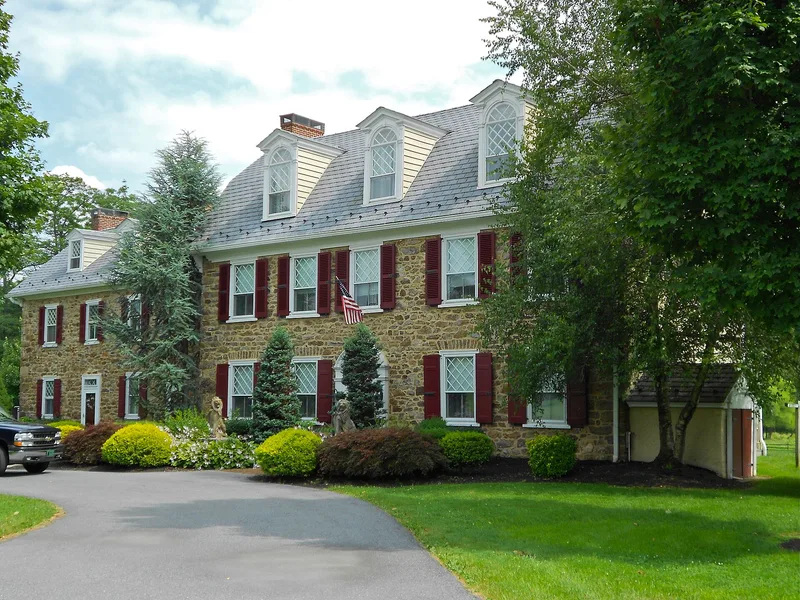
Windsor Forge Mansion is a group of four stone and stucco buildings in Churchtown, Lancaster County, sited along a hilltop above the hollow where the iron forge once operated. The main house was built in three sections, with the eastern part dating to about 1742, the western part to about 1765 and the middle connecting section to about 1815. Its rectilinear massing and original window openings survive, and its interior woodwork from the 1815 remodeling is in the Federal style. The Windsor Forge was operated by the Jenkins family, and under Robert Jenkins it reached its greatest output in the late 1790s and 1800s. Forge operations ceased in 1850. The property is regarded as an unusually intact survival of an ironmaster's house in rural Pennsylvania, with an English-derived gambrel roof and axial floor plan. It is also tied to sculptor Blanche Nevin, who lived there after 1899.
Machine-generated summary. This summary was generated by a language model from the official nomination document and has not been reviewed line by line by an editor. It may contain errors. Check the source document before relying on any detail. Source: nomination document (PDF) · catalog entry. Generated October 2026 (model claude-haiku-5-5, prompt v1.1-2026-10-29).
| Period of significance | 1742-1913 |
|---|---|
| Styles | Federal |
| Areas of significance | Industry, Art, Architecture |
| Acreage | 5 |
| Boundary source | not published |
| Full listing page | Windsor Forge Mansion (property record) |
What listing means for this property
This is a historic district. Buildings within its boundary are either contributing (they add to the district's significance) or non-contributing. Owners of contributing income-producing buildings can claim the 20% federal rehabilitation tax credit; homeowners should look at state credits. National Register districts impose no design review by themselves; a local historic district ordinance, if one exists, does (the difference explained).
Noted as vacant in the nomination. Nomination documents can be decades old; current status may differ. If you are considering buying an empty listed property, read the due-diligence checklist.
General information, not legal or tax advice. Rules change; confirm with your State Historic Preservation Office or a qualified adviser.