West Chester State College Quadrangle Historic District

Why it's listed
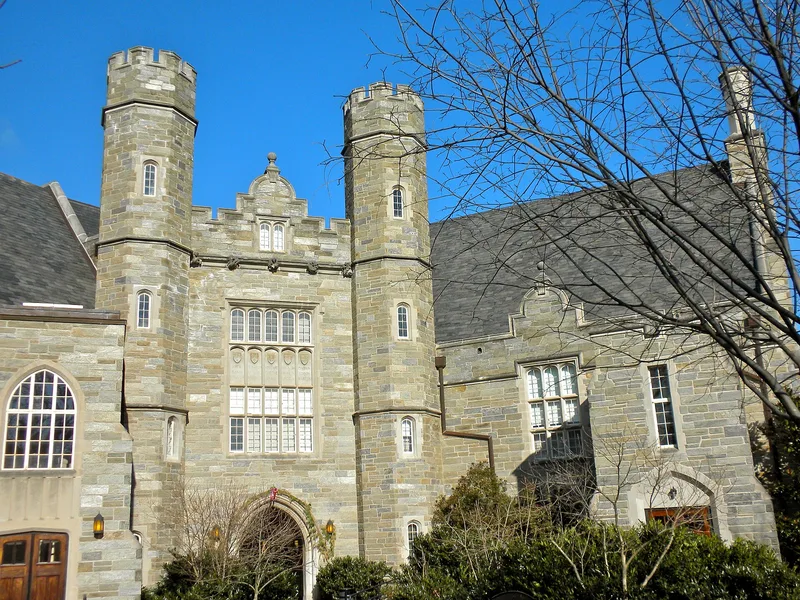
The West Chester State College quadrangle, a 12.6-acre campus in West Chester, Pennsylvania, is the school's original campus, laid out along High Street, College Avenue, Church Street and Rosedale Avenue. Its buildings are mostly built of local serpentine stone, a greenish metamorphic rock found only in Chester County and northern Maryland. Recitation Hall, designed by T. Roney Williamson and opened in 1893, was the fourth structure on the old campus. The Model School, designed in 1899 by the Philadelphia firm Baker and Dallett in a Georgian Revival style, was built to give students a place to observe teaching. The Library followed in 1902-04 with a classical facade and a tetrastyle Ionic portico. Philips Memorial Building, completed in 1927 in Collegiate Gothic style, was the quad's first building not built of serpentine. The district is regarded as significant because its serpentine examples are rare, the stone can no longer be quarried, and the buildings together show nearly a century of changing design and campus life.
Machine-generated summary. This summary was generated by a language model from the official nomination document and has not been reviewed line by line by an editor. It may contain errors. Check the source document before relying on any detail. Source: nomination document (PDF) · catalog entry. Generated October 2026 (model claude-haiku-5-5, prompt v1.1-2026-10-29).
| Period of significance | 1871-1975 |
|---|---|
| Styles | Collegiate Gothic; Georgian Revival; classical revival; Brutalism |
| Areas of significance | Education, Architecture |
| Acreage | 12.6 |
| Boundary source | NPS cultural-resource GIS polygon |
| Full listing page | West Chester State College Quadrangle Historic District (property record) |
What listing means for this property
This is a historic district. Buildings within its boundary are either contributing (they add to the district's significance) or non-contributing. Owners of contributing income-producing buildings can claim the 20% federal rehabilitation tax credit; homeowners should look at state credits. National Register districts impose no design review by themselves; a local historic district ordinance, if one exists, does (the difference explained).
General information, not legal or tax advice. Rules change; confirm with your State Historic Preservation Office or a qualified adviser.