Totten House

The National Park Service has not published a boundary polygon for this district; the map shows the listed properties inside it and the district's reference point.
Why it's listed
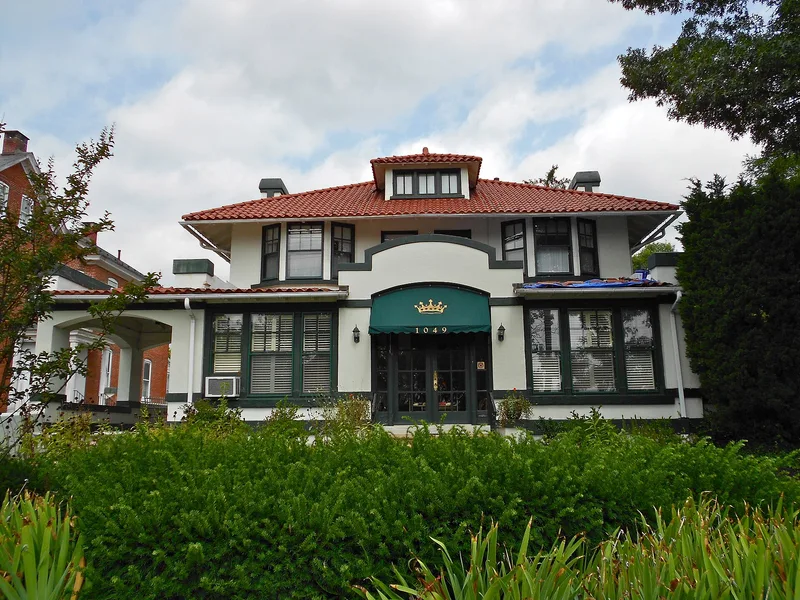
Built in 1913-14 for Frank Totten, a local dentist, this two-and-a-half story house on East King Street in eastern Lancaster Township is a stucco-faced example of Spanish Colonial and Mission style architecture. It has a red tile hipped roof with broadly overhanging eaves, tiled dormers, and a full-width tile-roofed enclosed porch with a porte-cochere. The house sits on a corner lot within Rohrer's East End Addition, laid out between 1892 and 1896. Its significance lies in its rarity in the region, where Colonial, Neoclassical and Tudor revivals were more common. The interior holds a range of early twentieth-century detailing, including a paneled-beamed living room, a classically detailed library, a colonial revival dining room, and stained and leaded glass with Arts and Crafts motifs. The house has a carriage house and a stuccoed wall that defines the long, narrow lot. The nomination regards it as the finest and most intact Spanish Colonial or Mission style house in Lancaster County.
Machine-generated summary. This summary was generated by a language model from the official nomination document and has not been reviewed line by line by an editor. It may contain errors. Check the source document before relying on any detail. Source: nomination document (PDF) · catalog entry. Generated October 2026 (model claude-haiku-5-5, prompt v1.1-2026-10-29).
| Period of significance | 1913-14 |
|---|---|
| Styles | Spanish Colonial/Mission revival |
| Areas of significance | Architecture |
| Acreage | 0.3 |
| Boundary source | not published |
| Full listing page | Totten House (property record) |
What listing means for this property
This is a historic district. Buildings within its boundary are either contributing (they add to the district's significance) or non-contributing. Owners of contributing income-producing buildings can claim the 20% federal rehabilitation tax credit; homeowners should look at state credits. National Register districts impose no design review by themselves; a local historic district ordinance, if one exists, does (the difference explained).
General information, not legal or tax advice. Rules change; confirm with your State Historic Preservation Office or a qualified adviser.