South Bethlehem Downtown Historic District

Why it's listed
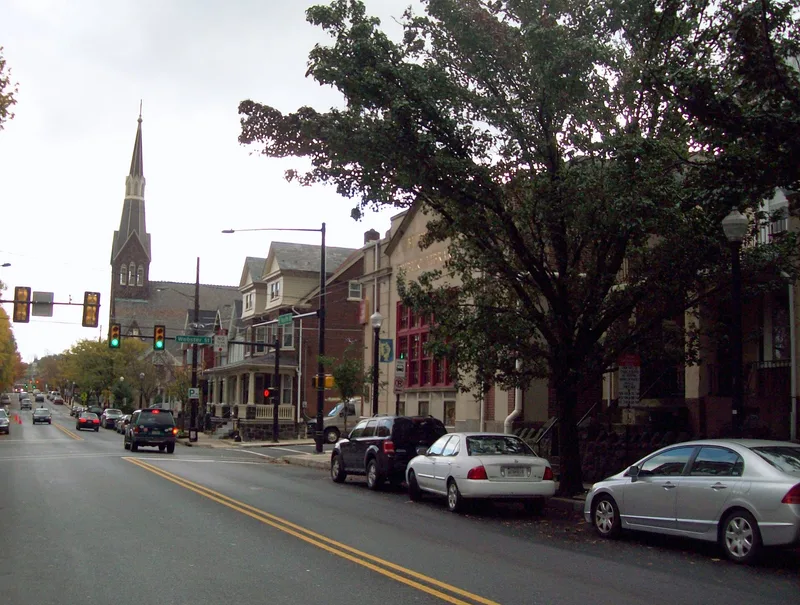
Two- to four-story brick commercial blocks line 3rd, 4th, Wyandotte and New streets in the South Bethlehem downtown, built mostly between about 1900 and 1935 on a grid laid out in the 1850s. The district holds 288 contributing buildings, with storefronts altered into the 1940s, while upper floors and cornices often remain largely intact. Early examples include the Italianate row known as Palace Row on Wyandotte Street, completed by 1877, and the Liberty Hose No. 1 of 1885 with corbelled brick, pressed metal cornice and terra cotta. Its importance rests on the district's role as the commercial and civic center of a community whose population grew from 3,556 in 1870 to 19,973 in 1910, largely through workers drawn to Bethlehem Steel. Business directories from 1890 and 1900 show dense retail, hotel and trade activity within its boundaries. Its streetscape illustrates the two-part commercial block form that dominated Victorian-era downtowns.
Machine-generated summary. This summary was generated by a language model from the official nomination document and has not been reviewed line by line by an editor. It may contain errors. Check the source document before relying on any detail. Source: nomination document (PDF) · catalog entry. Generated October 2026 (model claude-haiku-5-5, prompt v1.1-2026-10-29).
| Period of significance | 1874-1955 |
|---|---|
| Styles | Late Victorian; Italianate, Second Empire, Romanesque, Queen Anne; Beaux Arts, Moderne, Mediterranean Revival |
| Areas of significance | Commerce, Architecture |
| Acreage | 74 |
| Boundary source | NPS cultural-resource GIS polygon |
| Full listing page | South Bethlehem Downtown Historic District (property record) |
What listing means for this property
This is a historic district. Buildings within its boundary are either contributing (they add to the district's significance) or non-contributing. Owners of contributing income-producing buildings can claim the 20% federal rehabilitation tax credit; homeowners should look at state credits. National Register districts impose no design review by themselves; a local historic district ordinance, if one exists, does (the difference explained).
General information, not legal or tax advice. Rules change; confirm with your State Historic Preservation Office or a qualified adviser.