Milford Historic District

Why it's listed
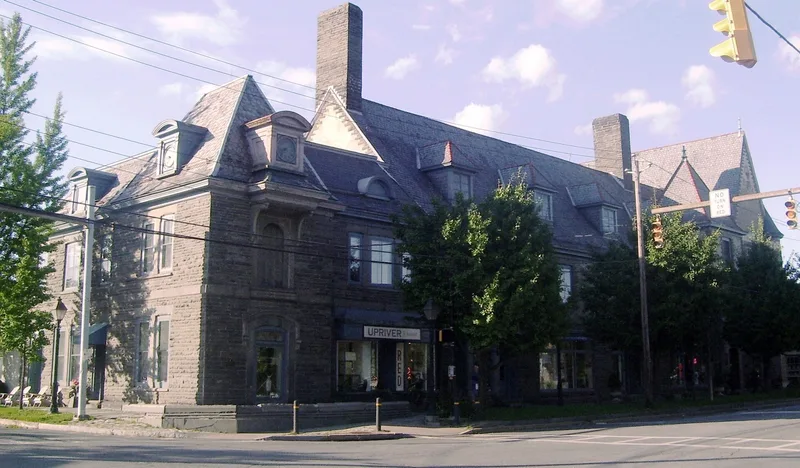
Milford's central business district lies along Broad Street in Pike County, Pennsylvania, on a bluff above the Delaware River. Laid out by the judge John Biddis in 1793 on a regular grid, the town became county seat, first of Wayne County in 1798 and then of Pike County in 1814. Its storefronts, hotels and civic buildings were largely built between 1820 and 1900, and many are Italianate in character, with Greek Revival, Gothic Revival, Romanesque Revival, Second Empire and Tudor Revival examples nearby. The district holds the 1872-74 Second Pike County Court House, the 1899 Milford Municipal Building and the 1904 Forester's Hall, which housed the Yale School of Forestry. Several buildings use native bluestone, a material tied to a late nineteenth-century quarrying industry. Milford's summer resort trade, with its hotels and visiting actors and artists, and its early film shoots, shaped the commercial life of the downtown.
Machine-generated summary. This summary was generated by a language model from the official nomination document and has not been reviewed line by line by an editor. It may contain errors. Check the source document before relying on any detail. Source: nomination document (PDF) · catalog entry. Generated October 2026 (model claude-haiku-5-5, prompt v1.1-2026-10-29).
| Period of significance | ca. 1740-ca. 1947 |
|---|---|
| Areas of significance | Commerce, Architecture, Politics/Government, Entertainment/Recreation, Conservation, Education |
| Acreage | 22 |
| Boundary source | NPS cultural-resource GIS polygon |
| Full listing page | Milford Historic District (property record) |
What listing means for this property
This is a historic district. Buildings within its boundary are either contributing (they add to the district's significance) or non-contributing. Owners of contributing income-producing buildings can claim the 20% federal rehabilitation tax credit; homeowners should look at state credits. National Register districts impose no design review by themselves; a local historic district ordinance, if one exists, does (the difference explained).
General information, not legal or tax advice. Rules change; confirm with your State Historic Preservation Office or a qualified adviser.