Longue Vue Club and Golf Course

Why it's listed
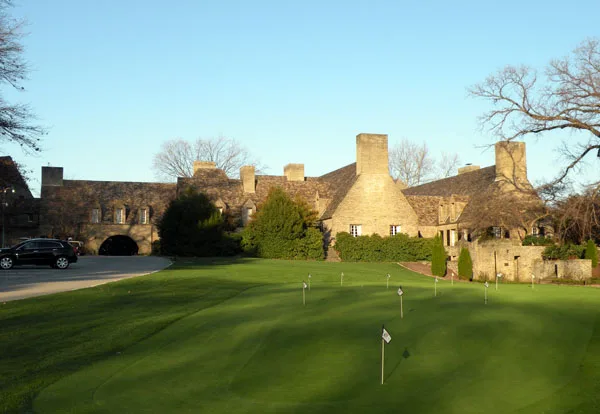
Perched on the highest point in Penn Hills Township, the Longue Vue Club is a country club whose two-and-a-half-story clubhouse was completed in 1923 in locally quarried tan sandstone laid in horizontal courses with thick white mortar joints. Architect Benno Janssen gave the building steep gables roofed in rough Vermont slate and an entrance drive that loops through two arched tunnels beneath the structure. The clubhouse is regarded as an uncommon English Norman design in southwestern Pennsylvania. Its 18-hole golf course was laid out by Robert White in 1922 on land that had been the Baggaley Farm, bought by a group of Pittsburgh executives in 1920. Landscape architect Albert Taylor's equestrian trails and the 1930s recreational buildings, including a pool, skeet lodge and shooting range, add to the district's collection of resources. The property is significant for its architecture and for its role in early country club and golf development in the Pittsburgh area.
Machine-generated summary. This summary was generated by a language model from the official nomination document and has not been reviewed line by line by an editor. It may contain errors. Check the source document before relying on any detail. Source: nomination document (PDF) · catalog entry. Generated October 2026 (model claude-haiku-5-5, prompt v1.1-2026-10-29).
| Period of significance | 1923-1954 |
|---|---|
| Styles | English Norman |
| Areas of significance | Architecture, Entertainment/Recreation, Landscape Architecture |
| Acreage | 356.3 |
| Boundary source | NPS cultural-resource GIS polygon |
| Full listing page | Longue Vue Club and Golf Course (property record) |
What listing means for this property
This is a historic district. Buildings within its boundary are either contributing (they add to the district's significance) or non-contributing. Owners of contributing income-producing buildings can claim the 20% federal rehabilitation tax credit; homeowners should look at state credits. National Register districts impose no design review by themselves; a local historic district ordinance, if one exists, does (the difference explained).
General information, not legal or tax advice. Rules change; confirm with your State Historic Preservation Office or a qualified adviser.