Leiby, Jacob, Farm

Why it's listed
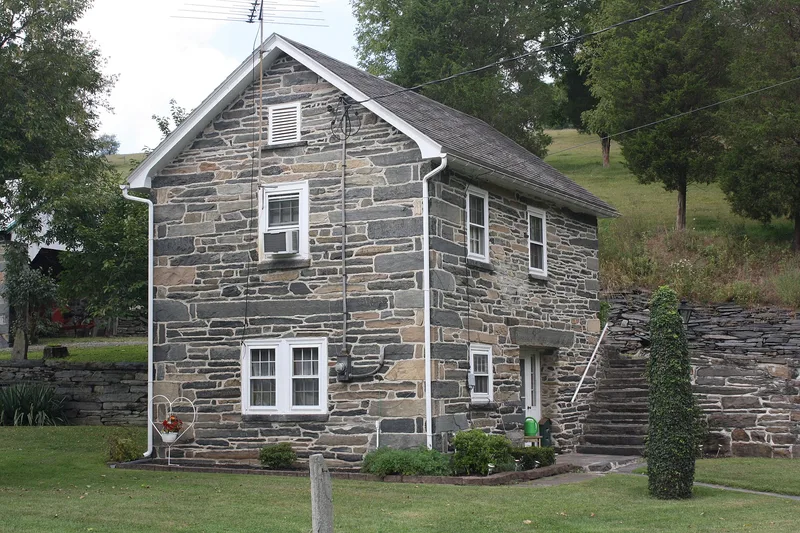
Built from 1829 onward, the Leiby farm in Virginville, Berks County, is a farmstead made almost entirely of stone cut from the quarry on its own land. Jacob Leiby, who ran the quarry from 1825 and died in 1884, developed the farm between 1829 and 1884. The farmhouse carries a datestone with his name and the year 1829. Its main buildings include a Federal-plan house, a Pennsylvania bank barn, a wagon shed, a cider house, a blacksmith shop later used as a school and then as a residence, a bakeoven and a double ground cellar. Stone was also used for fence posts, water troughs, paths, steps and garden edging. The quarry produced a sandstone known as Leiby blue stone, prized for its large slabs, and it supplied building stone across the region in the mid-1800s. The farm is regarded as a showcase of that stone and of the Pennsylvania German self-sufficient farmstead. Leiby's cemetery monument is also of stone, and the farm remained a working property through the twentieth century.
Machine-generated summary. This summary was generated by a language model from the official nomination document and has not been reviewed line by line by an editor. It may contain errors. Check the source document before relying on any detail. Source: nomination document (PDF) · catalog entry. Generated October 2026 (model claude-haiku-5-5, prompt v1.1-2026-10-29).
| Period of significance | 1829-1940 |
|---|---|
| Styles | Vernacular Federal House; Pennsylvania Bank Barn |
| Areas of significance | Agriculture, Architecture |
| Acreage | 92 |
| Boundary source | NPS cultural-resource GIS polygon |
| Full listing page | Leiby, Jacob, Farm (property record) |
What listing means for this property
This is a historic district. Buildings within its boundary are either contributing (they add to the district's significance) or non-contributing. Owners of contributing income-producing buildings can claim the 20% federal rehabilitation tax credit; homeowners should look at state credits. National Register districts impose no design review by themselves; a local historic district ordinance, if one exists, does (the difference explained).
General information, not legal or tax advice. Rules change; confirm with your State Historic Preservation Office or a qualified adviser.