Franklin and Marshall College Campus Historic District

Why it's listed
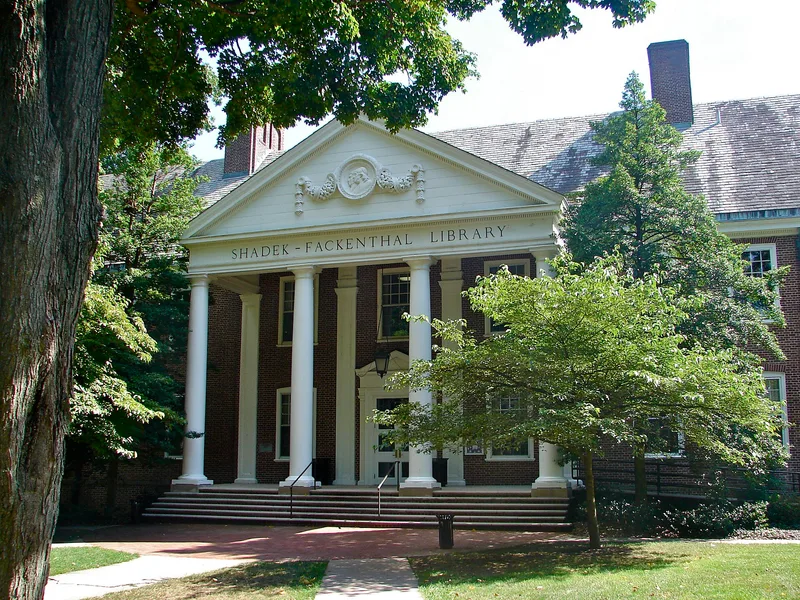
Franklin & Marshall College's campus district occupies about 23 acres of a 54-acre campus in northwest Lancaster, Pennsylvania, extending roughly a third of a mile along College Avenue. Its oldest buildings date from 1856 and form a Gothic Revival ensemble of red brick: the College Building, now Old Main, and the literary society halls, Diagnothian and Goethean, which were built to flank it. The district continues with buildings by Charles Z. Klauder from the 1920s, including Dietz-Santee and Franklin-Meyran halls, Hensel Hall and Fackenthal Laboratories, and with Georgian Revival buildings by William H. Lee from 1937 and 1938. Manning Alumni Green, planted in 1857 by students and faculty member Thomas Conrad Porter, is one of three landscape features in the district. The college regards the group as a record of how a liberal arts campus expanded and how American architectural taste moved from Gothic Revival to Colonial Revival between 1853 and 1953.
Machine-generated summary. This summary was generated by a language model from the official nomination document and has not been reviewed line by line by an editor. It may contain errors. Check the source document before relying on any detail. Source: nomination document (PDF) · catalog entry. Generated October 2026 (model claude-haiku-5-5, prompt v1.1-2026-10-29).
| Period of significance | 1853-1953 |
|---|---|
| Styles | Gothic Revival; Tudor Revival; Beaux Arts Classical; Colonial Revival |
| Areas of significance | Education, Architecture |
| Acreage | 23 |
| Boundary source | NPS cultural-resource GIS polygon |
| Full listing page | Franklin and Marshall College Campus Historic District (property record) |
What listing means for this property
This is a historic district. Buildings within its boundary are either contributing (they add to the district's significance) or non-contributing. Owners of contributing income-producing buildings can claim the 20% federal rehabilitation tax credit; homeowners should look at state credits. National Register districts impose no design review by themselves; a local historic district ordinance, if one exists, does (the difference explained).
General information, not legal or tax advice. Rules change; confirm with your State Historic Preservation Office or a qualified adviser.