Eakin, John, Farm

Why it's listed
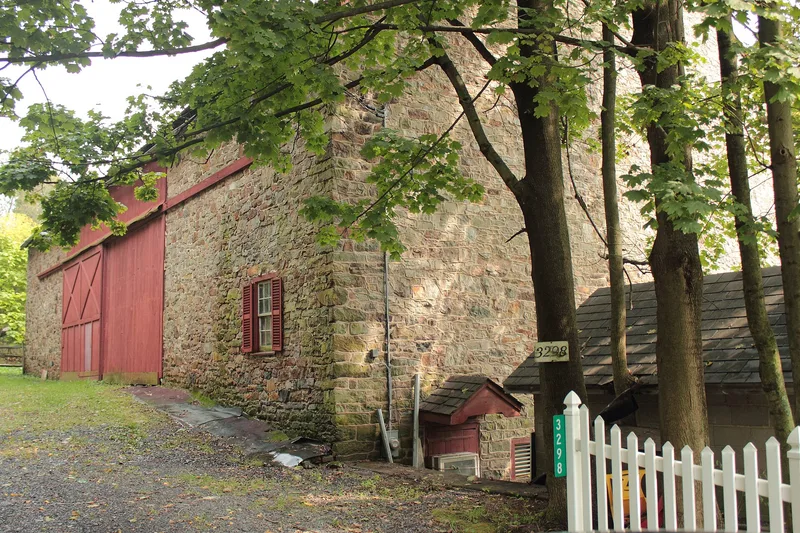
Along the south slope of a hill in Springfield Township, upper Bucks County, stands a farm complex built around Kooker's Tavern, a stone house raised in three sections between about 1739 and 1773. Stephen Twining built the east end, Jacob Kooker, a stone mason, added the middle section and tavern facilities, and a datestone above the front door carries the initials and date 1773 for the final west section. The English and German building traditions show in the two halves of the house. Nearby, the three-story stone Eakin Barn, built in the second quarter of the 19th century, has original hewn chestnut framing and a closed forebay. Other features include a late 18th-century springhouse set in a pond used as a fish hatchery, a mid-18th-century smokehouse, and the ruins of an early 19th-century summer kitchen. The property was used for milling, tavern keeping, lime burning, fish farming, and crop and dairy farming through 1947. It is important for its record of these combined activities and for its surviving stone buildings.
Machine-generated summary. This summary was generated by a language model from the official nomination document and has not been reviewed line by line by an editor. It may contain errors. Check the source document before relying on any detail. Source: nomination document (PDF) · catalog entry. Generated October 2026 (model claude-haiku-5-5, prompt v1.1-2026-10-29).
| Period of significance | 1737-1947 |
|---|---|
| Styles | Early Georgian; Penn Plan; Pennsylvania German closed-forebay bank barn; vernacular |
| Areas of significance | Agriculture, Commerce, Architecture |
| Acreage | 105.5 |
| Boundary source | NPS cultural-resource GIS polygon |
| Full listing page | Eakin, John, Farm (property record) |
What listing means for this property
This is a historic district. Buildings within its boundary are either contributing (they add to the district's significance) or non-contributing. Owners of contributing income-producing buildings can claim the 20% federal rehabilitation tax credit; homeowners should look at state credits. National Register districts impose no design review by themselves; a local historic district ordinance, if one exists, does (the difference explained).
General information, not legal or tax advice. Rules change; confirm with your State Historic Preservation Office or a qualified adviser.