Bryn Mawr College Historic District

Why it's listed
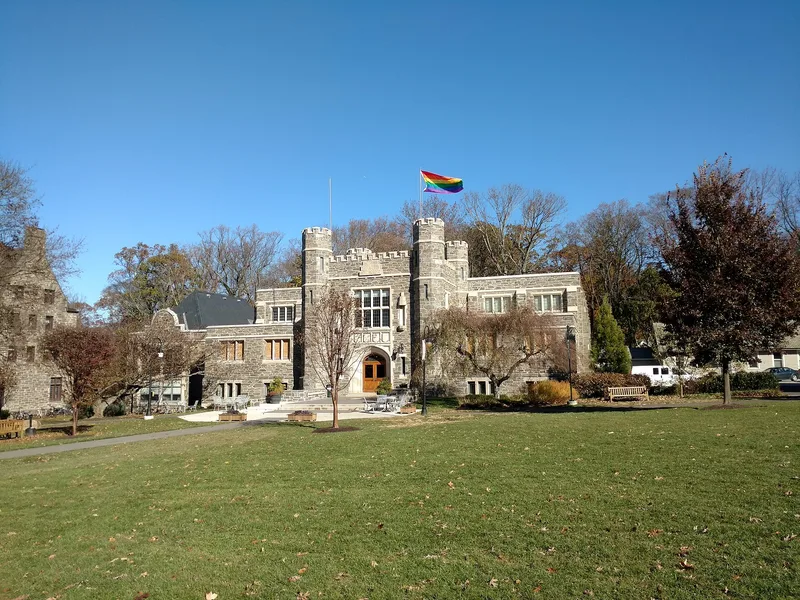
Bryn Mawr College's campus in Bryn Mawr, Pennsylvania, was laid out after the college opened in 1885 and contains buildings spanning three architectural periods. Addison Hutton's high Victorian Gothic Taylor Hall, completed in 1879 with its asymmetric tower, gives way to a series of collegiate Gothic buildings by Walter Cope and John Stewardson, including Denbigh, Pembroke and Thomas Library, which together formed the style the firm became known for. Goodhart Hall, completed in 1928, used a molded concrete skeleton behind its Gothic exterior, and Louis Kahn's Erdman Hall of 1963-65 reinterprets the campus's earlier forms. The college itself is tied to the advancement of women's education. Founded by Dr. Joseph Taylor, it was led from 1893 to 1922 by M. Carey Thomas, who pushed for entrance standards matching Harvard's and graduate degrees for women. The district is significant for both its architecture and its role in higher education for women.
Machine-generated summary. This summary was generated by a language model from the official nomination document and has not been reviewed line by line by an editor. It may contain errors. Check the source document before relying on any detail. Source: nomination document (PDF) · catalog entry. Generated October 2026 (model claude-haiku-5-5, prompt v1.1-2026-10-29).
| Period of significance | 1880-1929 |
|---|---|
| Styles | High Victorian Gothic; collegiate Gothic; modern interpretation of collegiate Gothic |
| Areas of significance | Landscape Architecture, Education, Architecture, Social History |
| Acreage | 49 |
| Boundary source | NPS cultural-resource GIS polygon |
| Full listing page | Bryn Mawr College Historic District (property record) |
What listing means for this property
This is a historic district. Buildings within its boundary are either contributing (they add to the district's significance) or non-contributing. Owners of contributing income-producing buildings can claim the 20% federal rehabilitation tax credit; homeowners should look at state credits. National Register districts impose no design review by themselves; a local historic district ordinance, if one exists, does (the difference explained).
General information, not legal or tax advice. Rules change; confirm with your State Historic Preservation Office or a qualified adviser.