Alpha Terrace Historic District

The National Park Service has not published a boundary polygon for this district; the map shows the listed properties inside it and the district's reference point.
Why it's listed
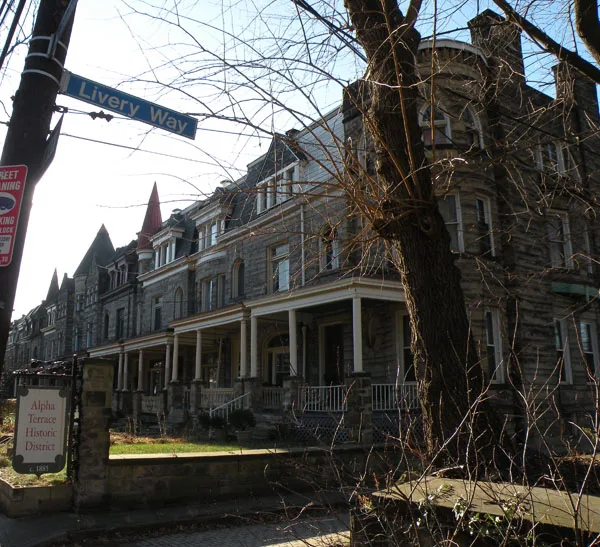
On N. Beatty Street in Pittsburgh, two facing rows of brick rowhouses with stone facades were built as speculative housing in 1889 and 1894. The east row has thirteen two-story Queen Anne houses, and the west row has twelve three-story houses that combine Richardsonian Romanesque and Queen Anne elements. Each row has individually varied bays, turrets, mansard roofs and stained or leaded glass, yet the two rows are formally related. Murphy and Hamilton are recorded as the builders on the 1893 and 1894 permits. The land had belonged to the Winebiddle and Negley families and was subdivided in 1885. The district is considered an unusually unified example of Victorian rowhouse design in a city where long, planned rows were rare. Its picturesque facades, which resemble free-standing houses, are seen as a unique product of Victorian-era Pittsburgh.
Machine-generated summary. This summary was generated by a language model from the official nomination document and has not been reviewed line by line by an editor. It may contain errors. Check the source document before relying on any detail. Source: nomination document (PDF) · catalog entry. Generated October 2026 (model claude-haiku-5-5, prompt v1.1-2026-10-29).
| Period of significance | 1900-1999 |
|---|---|
| Styles | Queen Anne; Richardsonian Romanesque and Queen Anne derivation |
| Areas of significance | Architecture |
| Acreage | 2 |
| Boundary source | not published |
| Full listing page | Alpha Terrace Historic District (property record) |
What listing means for this property
This is a historic district. Buildings within its boundary are either contributing (they add to the district's significance) or non-contributing. Owners of contributing income-producing buildings can claim the 20% federal rehabilitation tax credit; homeowners should look at state credits. National Register districts impose no design review by themselves; a local historic district ordinance, if one exists, does (the difference explained).
General information, not legal or tax advice. Rules change; confirm with your State Historic Preservation Office or a qualified adviser.