Wood County Courthouse And Jail

The National Park Service has not published a boundary polygon for this district; the map shows the listed properties inside it and the district's reference point.
Why it's listed
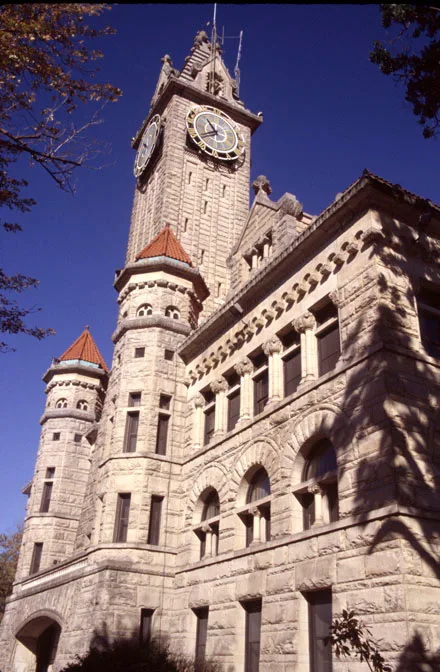
Wood County's courthouse and jail in Bowling Green were built between 1894 and 1896 and opened to the public in September 1896. The courthouse, described then as modernized Romanesque, has thick Vermont granite walls resting on solid rock, a tile roof, and a 185-foot clock tower flanked by six-sided towers. Carved stone on the entrance arch and gables depicts allegories of the law and the county's agriculture, oil, transportation and commerce. Inside are polished marble walls and stairways, bronze railings, frescoes, and a stained glass vaulted ceiling above the third floor corridor. The matching jail to the north is built of rock-faced ashlar stone with a central tower, dormers, gargoyles and a red tile roof. Oil industry tax revenue paid for the buildings, which replaced a hurried brick structure from 1869. Yost and Packard designed them, Whyte and Priest carved the sculpture, and the cost was about $200,000. Both buildings remain unaltered and in excellent condition.
Machine-generated summary. This summary was generated by a language model from the official nomination document and has not been reviewed line by line by an editor. It may contain errors. Check the source document before relying on any detail. Source: nomination document (PDF) · catalog entry. Generated October 2026 (model claude-sonnet-5-5, prompt v1.0-2026-10-29).
| Period of significance | 19th Century (built 1894-1896) |
|---|---|
| Styles | Modernized Romanesque |
| Areas of significance | Architecture |
| Acreage | 2.4 |
| Boundary source | not published |
| Full listing page | Wood County Courthouse And Jail (property record) |
What listing means for this property
This is a historic district. Buildings within its boundary are either contributing (they add to the district's significance) or non-contributing. Owners of contributing income-producing buildings can claim the 20% federal rehabilitation tax credit; homeowners should look at state credits. National Register districts impose no design review by themselves; a local historic district ordinance, if one exists, does (the difference explained).
General information, not legal or tax advice. Rules change; confirm with your State Historic Preservation Office or a qualified adviser.