Madison-Stewart Historic District

Why it's listed
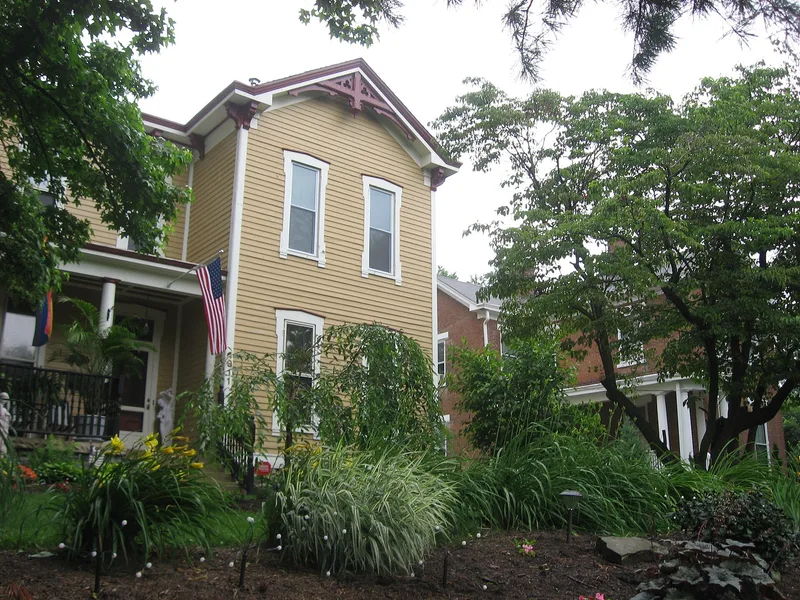
Madison Road and Stewart Avenue meet at the western edge of what was once the village of Madisonville, now part of Cincinnati. Around that crossing sits a compact district of mostly single-family houses built during the nineteenth century. The earliest and most prominent is the Federal-style Benjamin Stewart House at 5540 Madison Road, a brick building designed by his nephew William Stewart and built from lumber floated down the Ohio River. Nearby, Stewart Avenue holds Italianate houses at 4911, 4912 and 4915, a turreted frame house at 4904, and an Eastlake house at 4916. Brothers Charles and Jonathon Crugar built two of these houses after buying land from Benjamin M. Stewart in 1870. Many homes keep their carved wood mouldings, marble fireplaces and bracketed cornices. The district was recognized as a good collection of varied nineteenth-century vernacular buildings, with a period of significance from 1833 to about 1900.
Machine-generated summary. This summary was generated by a language model from the official nomination document and has not been reviewed line by line by an editor. It may contain errors. Check the source document before relying on any detail. Source: nomination document (PDF) · catalog entry. Generated October 2026 (model claude-sonnet-5-5, prompt v1.0-2026-10-29).
| Period of significance | 1833-c1900 |
|---|---|
| Styles | Nineteenth-century vernacular, including Federal, Italianate, Italian Villa and Eastlake |
| Areas of significance | Architecture |
| Acreage | 4 |
| Boundary source | NPS cultural-resource GIS polygon |
| Full listing page | Madison-Stewart Historic District (property record) |
What listing means for this property
This is a historic district. Buildings within its boundary are either contributing (they add to the district's significance) or non-contributing. Owners of contributing income-producing buildings can claim the 20% federal rehabilitation tax credit; homeowners should look at state credits. National Register districts impose no design review by themselves; a local historic district ordinance, if one exists, does (the difference explained).
General information, not legal or tax advice. Rules change; confirm with your State Historic Preservation Office or a qualified adviser.