Hoffner Historic District

The National Park Service has not published a boundary polygon for this district; the map shows the listed properties inside it and the district's reference point.
Why it's listed
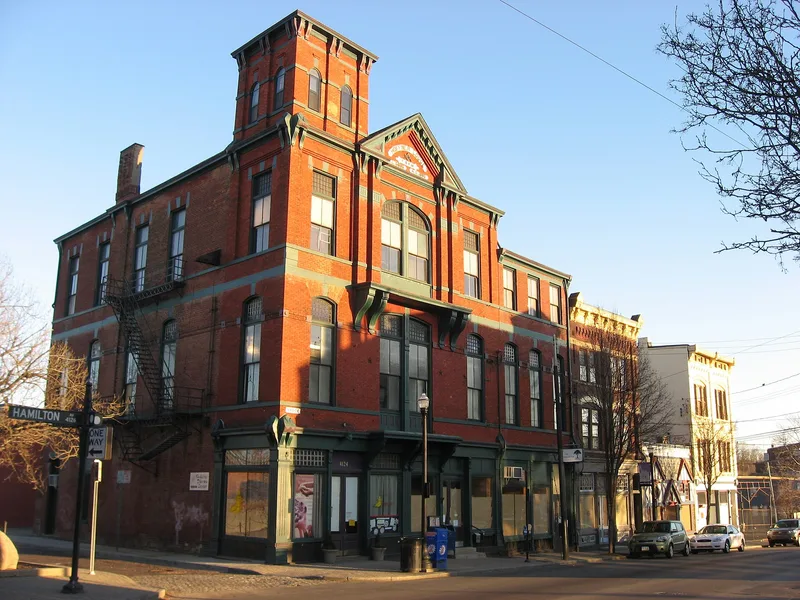
This five-acre district in Cincinnati's Cumminsville neighborhood gathers a lodge, shops, a former railroad freight depot and a row of houses around Hamilton Avenue, Moline Court, Langland Avenue and Blue Rock. The three-story brick Hoffner Lodge, built in 1885 on land donated by Jacob Hoffner, is a well preserved Italianate building with stone trim, paired windows, a projecting central bay and a tower that once carried a belfry. A post office has occupied its first floor since early in its history. Behind it stand six two-story residences in a German-influenced style, and beyond them the lumber company building, originally a Cincinnati, Hamilton and Dayton Railroad freight station built between 1880 and 1890. The nomination values the group as a nearly intact, unintruded example of late nineteenth century commercial and residential life, with a period of significance of 1873 to 1900.
Machine-generated summary. This summary was generated by a language model from the official nomination document and has not been reviewed line by line by an editor. It may contain errors. Check the source document before relying on any detail. Source: nomination document (PDF) · catalog entry. Generated October 2026 (model claude-sonnet-5-5, prompt v1.0-2026-10-29).
| Period of significance | 1873-1900 |
|---|---|
| Styles | Italianate (Hoffner Lodge); German-influenced late 19th century residential and commercial styles |
| Areas of significance | Architecture |
| Acreage | 5 |
| Boundary source | not published |
| Full listing page | Hoffner Historic District (property record) |
What listing means for this property
This is a historic district. Buildings within its boundary are either contributing (they add to the district's significance) or non-contributing. Owners of contributing income-producing buildings can claim the 20% federal rehabilitation tax credit; homeowners should look at state credits. National Register districts impose no design review by themselves; a local historic district ordinance, if one exists, does (the difference explained).
General information, not legal or tax advice. Rules change; confirm with your State Historic Preservation Office or a qualified adviser.