Baldwin-Wallace College North Campus Historic District

Why it's listed
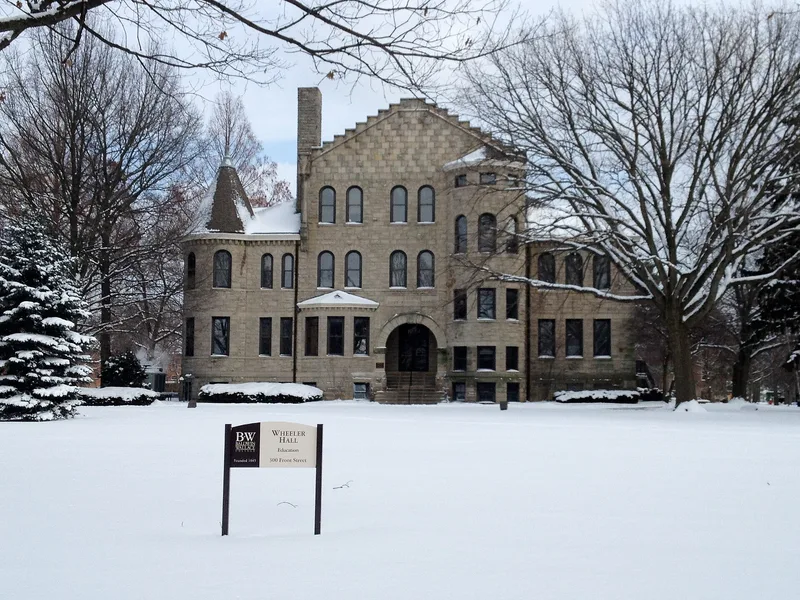
Baldwin-Wallace College's North Campus in Berea, Ohio, occupies a single block bounded by East Bagley Road, Front Street, East Fifth Avenue and Beech Street. Fourteen buildings and two sites, the North Quad and the Fullmer Arboretum, surround an open green space. Construction began in 1891 with Wheeler Hall, also called Recitation Hall, after Baldwin University left its original campus near the sandstone quarries because of noise and structural undermining. Ladies Hall, built in 1883, was taken apart stone by stone and rebuilt on the new site in 1905 as Carnegie Science Hall. The Philura Gould Baldwin Memorial Library, finished in 1894, is a Richardsonian Romanesque landmark. Later additions include Tudor Revival and Georgian Revival buildings of the 1920s and 1930s and mid-century halls up to 1966. The buildings are mostly Berea sandstone and brick, and they continue to serve as classrooms, offices, a library and student housing. The district records the move and growth of the university and college.
Machine-generated summary. This summary was generated by a language model from the official nomination document and has not been reviewed line by line by an editor. It may contain errors. Check the source document before relying on any detail. Source: nomination document (PDF) · catalog entry. Generated October 2026 (model claude-sonnet-5-5, prompt v1.0-2026-10-29).
| Styles | Late Victorian (High Victorian Gothic, Richardsonian Romanesque); Colonial Revival (Georgian Revival, Tudor Revival); Modern Movement (Moderne) |
|---|---|
| Areas of significance | Architecture, Education |
| Acreage | 20 |
| Boundary source | NPS cultural-resource GIS polygon |
| Full listing page | Baldwin-Wallace College North Campus Historic District (property record) |
What listing means for this property
This is a historic district. Buildings within its boundary are either contributing (they add to the district's significance) or non-contributing. Owners of contributing income-producing buildings can claim the 20% federal rehabilitation tax credit; homeowners should look at state credits. National Register districts impose no design review by themselves; a local historic district ordinance, if one exists, does (the difference explained).
General information, not legal or tax advice. Rules change; confirm with your State Historic Preservation Office or a qualified adviser.