Ashtabula County Courthouse Group

The National Park Service has not published a boundary polygon for this district; the map shows the listed properties inside it and the district's reference point.
Why it's listed
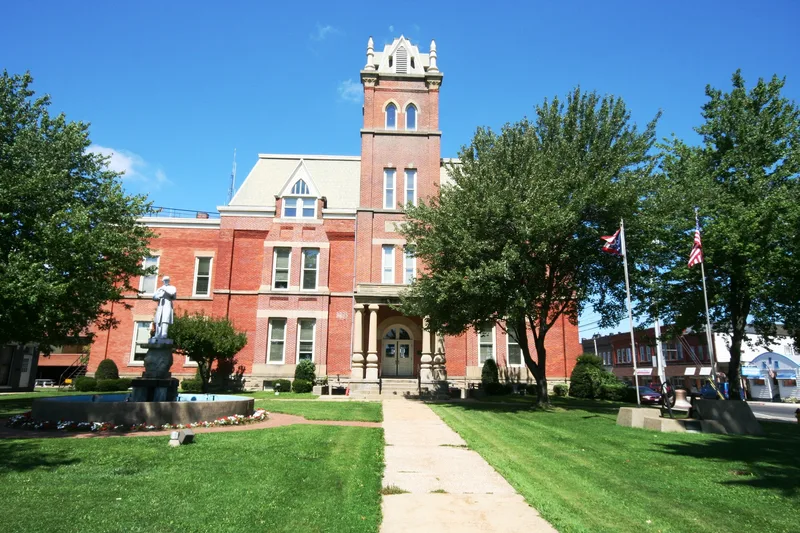
Five buildings around the public green in Jefferson, Ohio, make up this one-acre district at Jefferson and Chestnut Streets. The Ashtabula County Courthouse is the fourth courthouse on the site, after buildings of 1810 and 1836 and a Greek Revival structure rebuilt after a fire in 1850. John Woolly designed the 1891 front addition, which has a Queen Anne character, an entrance tower and a stone porch with paired columns. The 1850 portion remains at the rear. North of the courthouse, the Italianate Probate Court building dates from 1870, designed by Cleveland architect Levi T. Scofield and built by J. M. Watters. On the west side of the green, Lawyers' Row includes a depot-like frame office building and an Italianate brick building, and was standing by 1874. The green also holds a Civil War soldier memorial. The group was listed for its architecture, its role as the county's political and legal center, and its links to Benjamin Wade and Joshua Giddings.
Machine-generated summary. This summary was generated by a language model from the official nomination document and has not been reviewed line by line by an editor. It may contain errors. Check the source document before relying on any detail. Source: nomination document (PDF) · catalog entry. Generated October 2026 (model claude-sonnet-5-5, prompt v1.0-2026-10-29).
| Period of significance | 19th Century (specific dates 1850; 1870; 1891) |
|---|---|
| Styles | Queen Anne courthouse front over a Greek Revival core; Italianate and High Victorian Italianate buildings |
| Areas of significance | Community Planning and Development, Politics/Government, Architecture, Social History |
| Acreage | 1 |
| Boundary source | not published |
| Full listing page | Ashtabula County Courthouse Group (property record) |
What listing means for this property
This is a historic district. Buildings within its boundary are either contributing (they add to the district's significance) or non-contributing. Owners of contributing income-producing buildings can claim the 20% federal rehabilitation tax credit; homeowners should look at state credits. National Register districts impose no design review by themselves; a local historic district ordinance, if one exists, does (the difference explained).
General information, not legal or tax advice. Rules change; confirm with your State Historic Preservation Office or a qualified adviser.