Ambler Heights Historic District
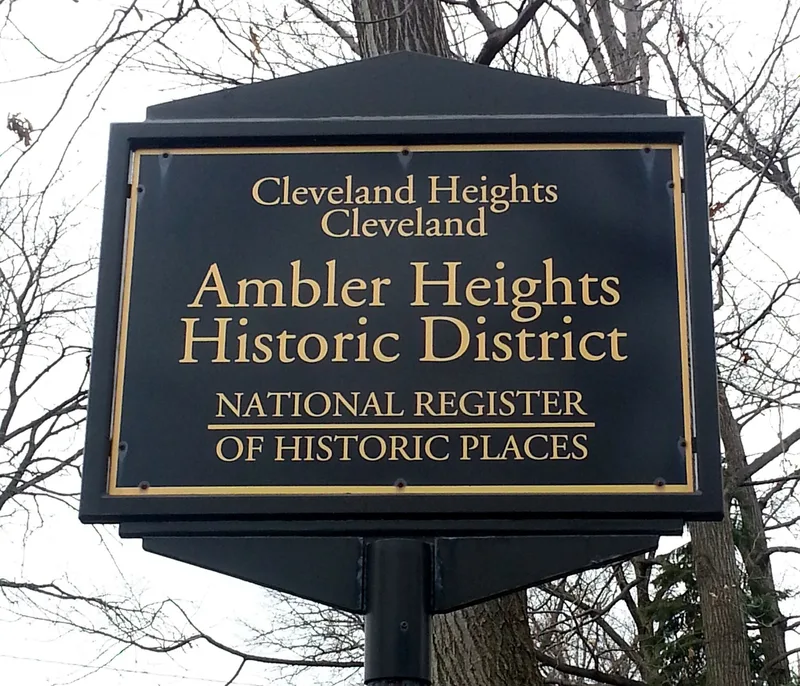

Why it's listed
Ambler Heights is an upscale residential neighborhood of about 73 acres, mostly in southwest Cleveland Heights, Ohio, with a small part inside Cleveland. Charles W. Pratt laid out the plan in 1900 for Daniel O. Caswell, adopted son of the dentist and real estate developer Dr. Nathan Hardy Ambler, and building ran from about 1903 to 1927. Wide, gently curving streets, generous irregular lots, mature trees and ravines on the south and west give the area a contained, park-like feel. Deed restrictions set minimum frontages, setbacks and home values and barred multi-family dwellings. Cleveland business leaders commissioned large homes from well-known architects such as Frank B. Meade, Meade and Hamilton, Walker and Weeks and Abram Garfield. Most are Tudor Revival or Colonial Revival, with some Italian Renaissance, Prairie School, French Renaissance and Shingle examples. The district counts 112 contributing buildings and three contributing structures, and it has changed little since its original development.
Machine-generated summary. This summary was generated by a language model from the official nomination document and has not been reviewed line by line by an editor. It may contain errors. Check the source document before relying on any detail. Source: nomination document (PDF) · catalog entry. Generated October 2026 (model claude-sonnet-5-5, prompt v1.0-2026-10-29).
| Styles | Late 19th and 20th Century Revivals (Colonial Revival, Tudor Revival, Georgian Revival, Italian Renaissance Revival, French Renaissance Revival); Prairie School; Craftsman; Shingle Style |
|---|---|
| Areas of significance | Architecture, Community Planning and Development |
| Acreage | 73 |
| Boundary source | NPS cultural-resource GIS polygon |
| Full listing page | Ambler Heights Historic District (property record) |
What listing means for this property
This is a historic district. Buildings within its boundary are either contributing (they add to the district's significance) or non-contributing. Owners of contributing income-producing buildings can claim the 20% federal rehabilitation tax credit; homeowners should look at state credits. National Register districts impose no design review by themselves; a local historic district ordinance, if one exists, does (the difference explained).
General information, not legal or tax advice. Rules change; confirm with your State Historic Preservation Office or a qualified adviser.