St. Luke's Church and Cemetery

The National Park Service has not published a boundary polygon for this district; the map shows the listed properties inside it and the district's reference point.
Why it's listed
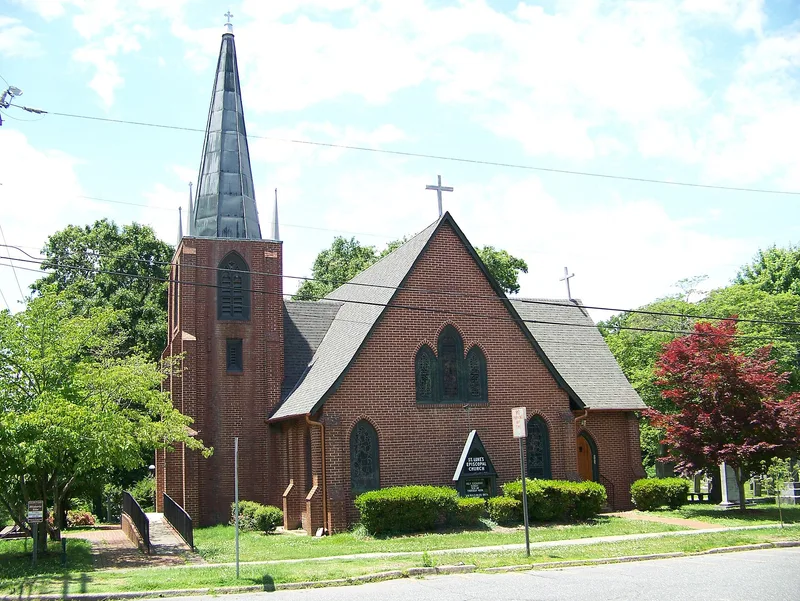
Set in a residential neighborhood of Lincolnton, St. Luke's Church and Cemetery is an Episcopal complex that includes a Gothic Revival church, parish hall, rectory and burying ground. The church was built in 1885-1886 on an east-west axis, with design and much of the interior carving credited to Silas McBee. Its bell tower, now the south transept, is traditionally the entrance tower of the congregation's first church of 1842-1843, whose steeple was rebuilt in 1859. A pebble-dash coating added in 1917 failed, and brick veneer replaced it in 1922-1923. Inside, pine, oak and chestnut woodwork, stained glass, a carved rood screen, altar and reredos survive from the Victorian period. The cemetery holds about 300 gravestones, including the Guion obelisk and iron-fenced plots of Civil War dead such as Major General Stephen Dodson Ramseur. The ministry of Rev. William R. Wetmore, which ended with his death in 1904, shaped the parish's history.
Machine-generated summary. This summary was generated by a language model from the official nomination document and has not been reviewed line by line by an editor. It may contain errors. Check the source document before relying on any detail. Source: nomination document (PDF) · catalog entry. Generated October 2026 (model claude-sonnet-5-5, prompt v1.0-2026-10-29).
| Styles | Gothic Revival; Colonial Revival |
|---|---|
| Areas of significance | Art, Architecture |
| Acreage | 2.2 |
| Boundary source | not published |
| Full listing page | St. Luke's Church and Cemetery (property record) |
What listing means for this property
This is a historic district. Buildings within its boundary are either contributing (they add to the district's significance) or non-contributing. Owners of contributing income-producing buildings can claim the 20% federal rehabilitation tax credit; homeowners should look at state credits. National Register districts impose no design review by themselves; a local historic district ordinance, if one exists, does (the difference explained).
General information, not legal or tax advice. Rules change; confirm with your State Historic Preservation Office or a qualified adviser.