Rigsbee's Rock House

The National Park Service has not published a boundary polygon for this district; the map shows the listed properties inside it and the district's reference point.
Why it's listed
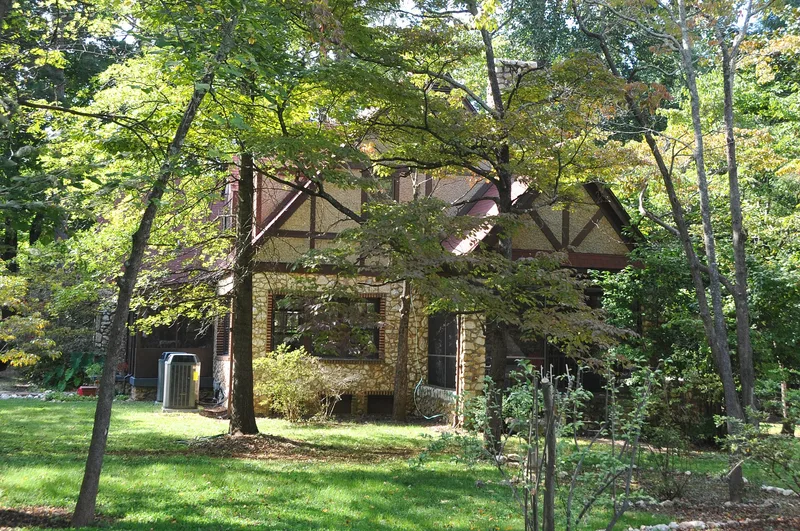
Built around 1929 about two miles east of Hillsborough, this one-and-a-half-story Tudor Revival house is made of white flint rubble rock with half-timbered gables and dormers. The 1.84-acre lot also holds a garage, pump house, swimming pool, planters, an arch and a low rock wall, all of the same stone. The architect and builder are unknown, though the stonework resembles that of Durham bungalows, which suggests Black stone masons may have worked on it. The house was built for Mack Rigsbee and his wife, who bought the lots in 1927 and 1928 and lost the property to default in 1931. Rigsbee was later convicted of illegal possession of whiskey, and local lore links the roomy attic spaces, a reinforced bathroom floor and a concealed faucet tank to bootlegging. The property is considered locally significant for its architecture and as a rare documented site associated with Orange County's Depression-era bootlegging. A careful restoration in 1986-87 preserved most original fabric.
Machine-generated summary. This summary was generated by a language model from the official nomination document and has not been reviewed line by line by an editor. It may contain errors. Check the source document before relying on any detail. Source: nomination document (PDF) · catalog entry. Generated October 2026 (model claude-sonnet-5-5, prompt v1.0-2026-10-29).
| Period of significance | 1929-1931 |
|---|---|
| Styles | Tudor Revival |
| Areas of significance | Architecture, Social History |
| Acreage | 1.8 |
| Boundary source | not published |
| Full listing page | Rigsbee's Rock House (property record) |
What listing means for this property
This is a historic district. Buildings within its boundary are either contributing (they add to the district's significance) or non-contributing. Owners of contributing income-producing buildings can claim the 20% federal rehabilitation tax credit; homeowners should look at state credits. National Register districts impose no design review by themselves; a local historic district ordinance, if one exists, does (the difference explained).
General information, not legal or tax advice. Rules change; confirm with your State Historic Preservation Office or a qualified adviser.