Woodbine-Palmetto-Gates Historic District

The National Park Service has not published a boundary polygon for this district; the map shows the listed properties inside it and the district's reference point.
Why it's listed
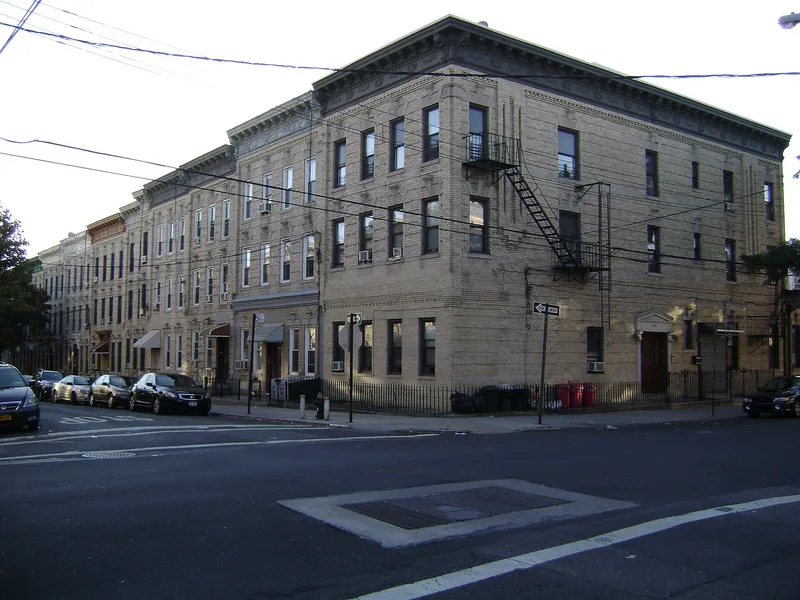
This 8-acre district in Ridgewood, Queens, covers about three and a half city blocks and contains 91 buildings put up between 1908 and 1911. Most are three-story brick tenements with two apartments per floor, built by the G.X. Mathews Co. to designs by Louis Allmendinger. The rows differ by street: Palmetto Street's buildings use yellow brick with burnt orange trim and varied window lintels, Woodbine Street's use flat cast-stone lintels, and Gates Avenue's use pale amber brick with brown rock-faced bands. A row at 706 to 720 Forest Avenue has unusually angled bays above storefronts. The district is notable as an intact collection of "Mathews Flats," an early model tenement type whose floor plans and sanitary facilities became standards for later construction. It includes the earliest fully developed examples of the type in the surrounding resource area. Alterations have been modest, mainly new stoops, doors, awnings and storefronts, and the boundaries exclude nearby frame and commercial buildings that do not match the character.
Machine-generated summary. This summary was generated by a language model from the official nomination document and has not been reviewed line by line by an editor. It may contain errors. Check the source document before relying on any detail. Source: nomination document (PDF) · catalog entry. Generated October 2026 (model claude-sonnet-5-5, prompt v1.0-2026-10-29).
| Period of significance | 1908-1911 |
|---|---|
| Styles | Romanesque and Renaissance Revival detail |
| Areas of significance | Architecture |
| Acreage | 8 |
| Boundary source | not published |
| Full listing page | Woodbine-Palmetto-Gates Historic District (property record) |
What listing means for this property
This is a historic district. Buildings within its boundary are either contributing (they add to the district's significance) or non-contributing. Owners of contributing income-producing buildings can claim the 20% federal rehabilitation tax credit; homeowners should look at state credits. National Register districts impose no design review by themselves; a local historic district ordinance, if one exists, does (the difference explained).
General information, not legal or tax advice. Rules change; confirm with your State Historic Preservation Office or a qualified adviser.