Willoughby-Suydam Historic District

The National Park Service has not published a boundary polygon for this district; the map shows the listed properties inside it and the district's reference point.
Why it's listed
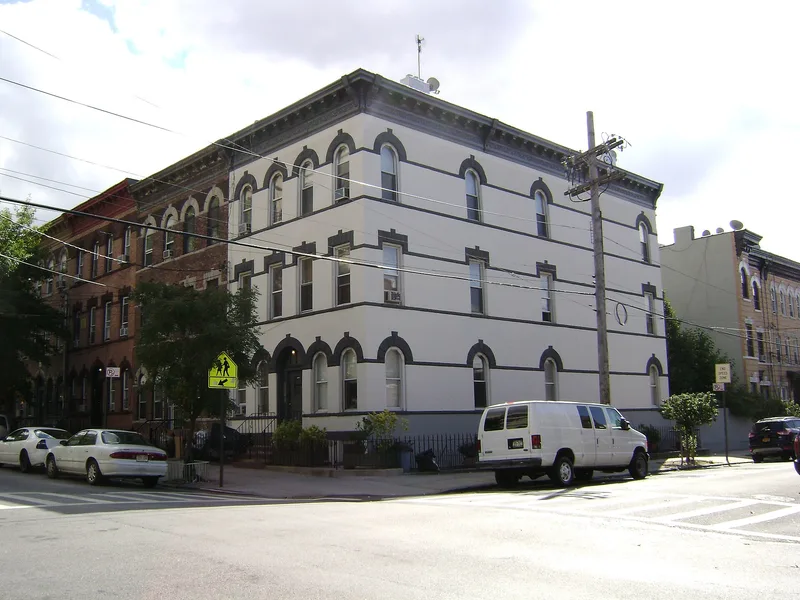
Fifty three-story brick tenements, built between 1904 and 1906, make up this four-acre district in the Brooklyn part of Ridgewood. The rows line Willoughby Avenue, Suydam Street, Wyckoff Avenue and St. Nicholas Avenue, and each floor holds two apartments. They stand apart from the large industrial buildings and altered frame houses nearby. Robert T. Rasmussen designed and built the rows on Willoughby, Suydam and Wyckoff, which feature yellow and white terra-cotta ornament such as Greek fret bands and wreath-and-ribbon lintels. Louis Berger designed the St. Nicholas Avenue rows, built by Jacob Blank in 1904, with brownstone trim in the Romanesque Revival style. Because the area lay in Brooklyn, an earlier fire code required masonry, giving the district some of the earliest all-brick rows in Ridgewood. The narrow, dark apartments reflect tenement design before the Mathews Model Flat. Some buildings are vacant and deteriorating, while most of the district remains stable.
Machine-generated summary. This summary was generated by a language model from the official nomination document and has not been reviewed line by line by an editor. It may contain errors. Check the source document before relying on any detail. Source: nomination document (PDF) · catalog entry. Generated October 2026 (model claude-sonnet-5-5, prompt v1.0-2026-10-29).
| Styles | Romanesque, Renaissance and Classical Revival detailing; Romanesque Revival brownstone trim on the St. Nicholas Avenue rows |
|---|---|
| Areas of significance | Architecture |
| Acreage | 4 |
| Boundary source | not published |
| Full listing page | Willoughby-Suydam Historic District (property record) |
What listing means for this property
This is a historic district. Buildings within its boundary are either contributing (they add to the district's significance) or non-contributing. Owners of contributing income-producing buildings can claim the 20% federal rehabilitation tax credit; homeowners should look at state credits. National Register districts impose no design review by themselves; a local historic district ordinance, if one exists, does (the difference explained).
General information, not legal or tax advice. Rules change; confirm with your State Historic Preservation Office or a qualified adviser.