Wappingers Falls Historic District

Why it's listed
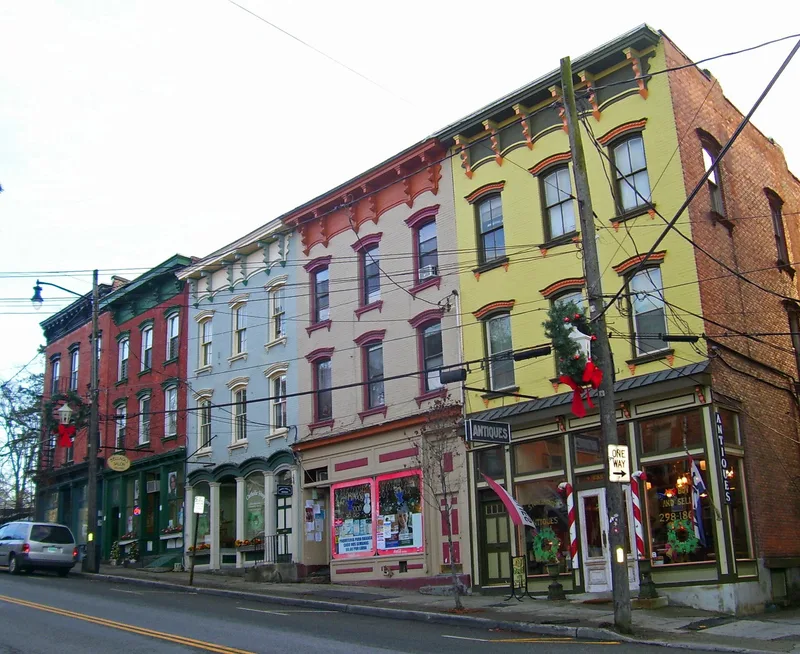
Wappingers Falls Historic District covers roughly 90 acres of the village in Dutchess County, New York, and takes in industrial, commercial and residential areas. At its heart is a hollow below the falls of Wappingers Creek, where a small cotton mill of 1819 grew into one of the nation's most extensive printworks complexes. Fourteen surviving masonry buildings, a power house, a pump house, a bridge and a penstock remain from it. Nearby hillside streets hold double houses built for mill employees between about 1850 and 1880. Main Street is lined with attached three-story buildings, mostly from after the Civil War, along with an 1884 twin-arch sandstone bridge, the 1887 Shingle style library and an 1871 former bank. Mesier Park centers on the 1740s Brewer-Mesier House, a pre-Revolutionary Hudson Valley dwelling. South Avenue displays Greek Revival through Colonial Revival homes and churches. Together these resources show how the village developed around its mills.
Machine-generated summary. This summary was generated by a language model from the official nomination document and has not been reviewed line by line by an editor. It may contain errors. Check the source document before relying on any detail. Source: nomination document (PDF) · catalog entry. Generated October 2026 (model claude-sonnet-5-5, prompt v1.0-2026-10-29).
| Styles | Mixed: Greek Revival, Gothic Revival, Italianate, Second Empire, Queen Anne, Shingle and Colonial Revival |
|---|---|
| Areas of significance | Industry, Architecture |
| Acreage | 90 |
| Boundary source | NPS cultural-resource GIS polygon |
| Full listing page | Wappingers Falls Historic District (property record) |
What listing means for this property
This is a historic district. Buildings within its boundary are either contributing (they add to the district's significance) or non-contributing. Owners of contributing income-producing buildings can claim the 20% federal rehabilitation tax credit; homeowners should look at state credits. National Register districts impose no design review by themselves; a local historic district ordinance, if one exists, does (the difference explained).
General information, not legal or tax advice. Rules change; confirm with your State Historic Preservation Office or a qualified adviser.