State Street-Henry Street Historic District (Boundary Increase)

The National Park Service has not published a boundary polygon for this district; the map shows the listed properties inside it and the district's reference point.
Why it's listed
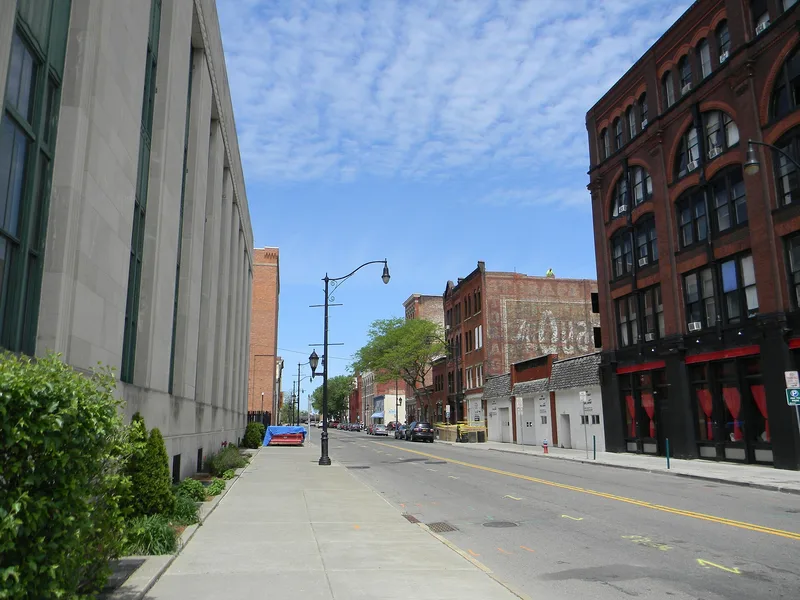
North of Binghamton's central business district, a cluster of 22 buildings along State Street and Henry Street preserves the look of a late nineteenth-century commercial and manufacturing area. The corridor began as the route of the Chenango Canal, built between 1833 and 1837. After the canal closed in 1877 and State Street replaced it, a second generation of buildings arose, helped by the nearby railroad yards. Most are brick, average about four stories, and were built between 1876 and 1935. Romanesque commercial blocks, a castellated state armory, a Queen Anne store, a cigar-factory complex and a limestone 1935 post office and courthouse with Neoclassical and Art Deco details show the range of styles. Businesses once included cigar makers, newspaper printers, grocers, a candy factory and a scale works. Most alterations affect only first-story facades. Intact streetscapes, consistent scale and high architectural integrity are the reasons for the district's recognition.
Machine-generated summary. This summary was generated by a language model from the official nomination document and has not been reviewed line by line by an editor. It may contain errors. Check the source document before relying on any detail. Source: nomination document (PDF) · catalog entry. Generated October 2026 (model claude-sonnet-5-5, prompt v1.0-2026-10-29).
| Period of significance | 1877-1935 |
|---|---|
| Styles | Romanesque, Queen Anne, Beaux-Arts, Neoclassical and Art Deco |
| Areas of significance | Architecture, Community Planning and Development |
| Acreage | 8.9 |
| Boundary source | not published |
| Full listing page | State Street-Henry Street Historic District (Boundary Increase) (property record) |
What listing means for this property
This is a historic district. Buildings within its boundary are either contributing (they add to the district's significance) or non-contributing. Owners of contributing income-producing buildings can claim the 20% federal rehabilitation tax credit; homeowners should look at state credits. National Register districts impose no design review by themselves; a local historic district ordinance, if one exists, does (the difference explained).
General information, not legal or tax advice. Rules change; confirm with your State Historic Preservation Office or a qualified adviser.