Stafford Village Four Corners Historic District

The National Park Service has not published a boundary polygon for this district; the map shows the listed properties inside it and the district's reference point.
Why it's listed
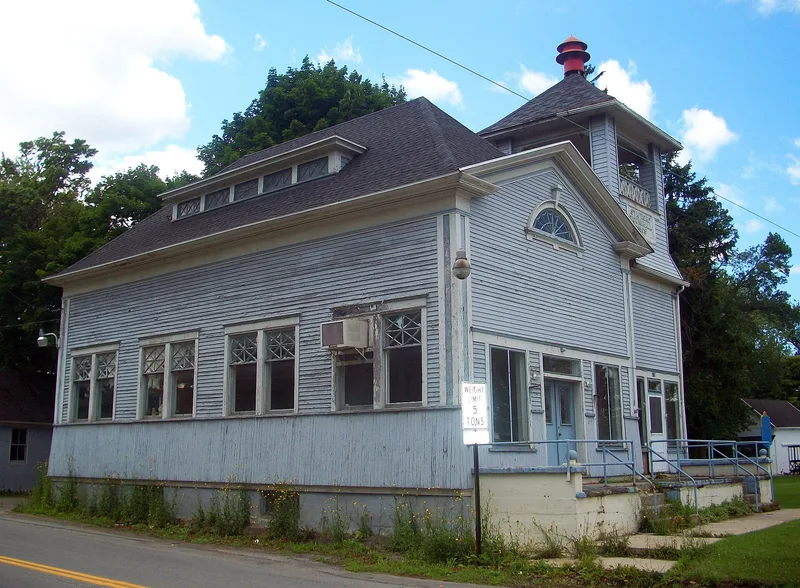
Six buildings clustered around the crossing of Routes 5 and 237 form the core of Stafford, a small hamlet in Genesee County, New York. The group includes a former store that became the Town Hall, two private houses, a church, a former seminary and an Odd Fellows Hall. They date from about 1809 to 1890 and show Federal, Greek Revival, Gothic Revival and vernacular design. The brick Marvin-Radley-Diefendorf house, begun about 1809, is among the earliest surviving homes in the county. The Radley-Worthington House, built about 1831 by the Rev. Richard Radley, is cited as an especially fine Greek Revival example. The site also holds historical weight: Stafford began in 1798 as a transit station for surveyor Joseph Ellicott of the Holland Land Company and was the first settlement on the Holland Purchase Tract. A park on one corner marks the site of the Hotel Stafford, built in 1804. The district was valued for its good preservation and lack of modern intrusions.
Machine-generated summary. This summary was generated by a language model from the official nomination document and has not been reviewed line by line by an editor. It may contain errors. Check the source document before relying on any detail. Source: nomination document (PDF) · catalog entry. Generated October 2026 (model claude-sonnet-5-5, prompt v1.0-2026-10-29).
| Period of significance | 1800-1899 |
|---|---|
| Styles | Greek Revival, Gothic Revival, Federal and vernacular influences (listed as Eclectic, Gothic Revival) |
| Areas of significance | Exploration/Settlement, Architecture |
| Acreage | 5.8 |
| Boundary source | not published |
| Full listing page | Stafford Village Four Corners Historic District (property record) |
What listing means for this property
This is a historic district. Buildings within its boundary are either contributing (they add to the district's significance) or non-contributing. Owners of contributing income-producing buildings can claim the 20% federal rehabilitation tax credit; homeowners should look at state credits. National Register districts impose no design review by themselves; a local historic district ordinance, if one exists, does (the difference explained).
General information, not legal or tax advice. Rules change; confirm with your State Historic Preservation Office or a qualified adviser.