St. Lawrence University-Old Campus Historic District

Why it's listed
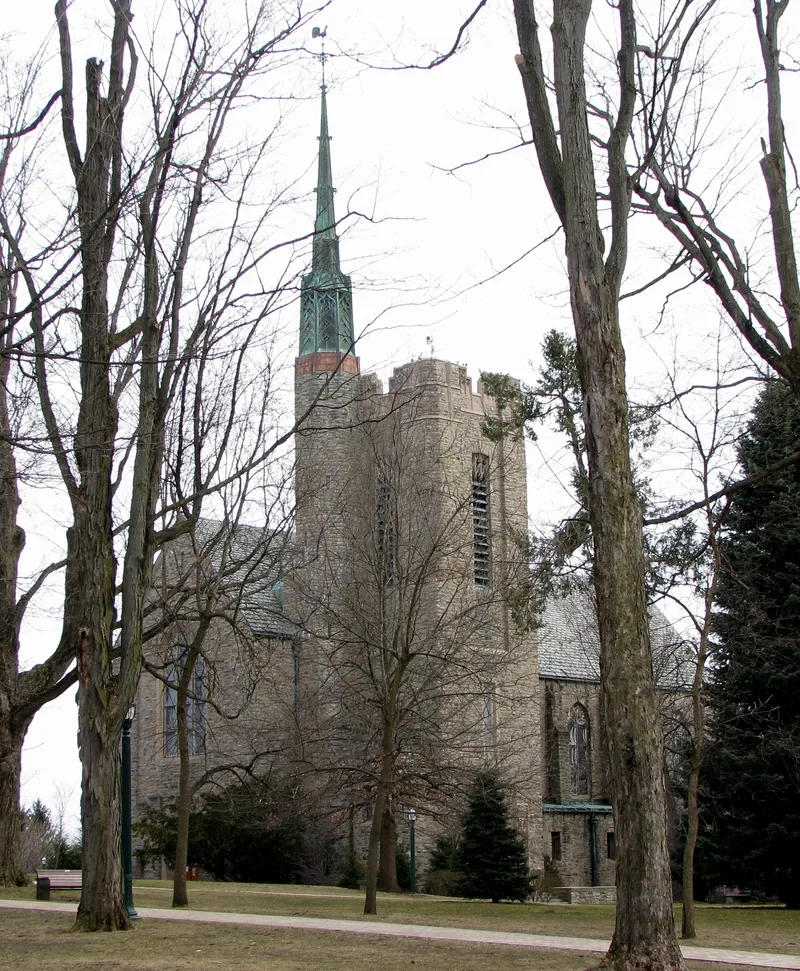
Ten buildings on 23 acres make up the oldest part of the St. Lawrence University campus in Canton, New York. Two of them, Richardson Hall and Herring-Cole Hall, date from the 1850s to 1870 and were listed individually in 1974. The remaining contributing buildings went up in two later waves. From 1904 to 1911 came Carnegie, Cook, Payson and Memorial Halls, the last two linked to a state agricultural school and a Weather Bureau station. From 1924 to 1930 came Gunnison Chapel, Hepburn Hall, Dean-Eaton Hall, Sykes Residence and the Beta Theta Pi temple. The chapel, Hepburn Hall and Dean-Eaton Hall follow designs by architect Bertram G. Goodhue, completed after his death in 1924, and form the only group of his work in northern New York. Trustee chairman Owen D. Young helped shape several of these projects. By 1930 the campus had separate science and arts classrooms, a chapel, a library and dormitories, a core that later construction only expanded.
Machine-generated summary. This summary was generated by a language model from the official nomination document and has not been reviewed line by line by an editor. It may contain errors. Check the source document before relying on any detail. Source: nomination document (PDF) · catalog entry. Generated October 2026 (model claude-sonnet-5-5, prompt v1.0-2026-10-29).
| Period of significance | 1856-1930 |
|---|---|
| Styles | Varied early 20th-century styles, including Gothic Revival, Georgian Revival, Classical Revival and Spanish Baroque-influenced design |
| Areas of significance | Education, Architecture |
| Acreage | 23 |
| Boundary source | NPS cultural-resource GIS polygon |
| Full listing page | St. Lawrence University-Old Campus Historic District (property record) |
What listing means for this property
This is a historic district. Buildings within its boundary are either contributing (they add to the district's significance) or non-contributing. Owners of contributing income-producing buildings can claim the 20% federal rehabilitation tax credit; homeowners should look at state credits. National Register districts impose no design review by themselves; a local historic district ordinance, if one exists, does (the difference explained).
General information, not legal or tax advice. Rules change; confirm with your State Historic Preservation Office or a qualified adviser.