South End-Groesbeckville Historic District

Why it's listed
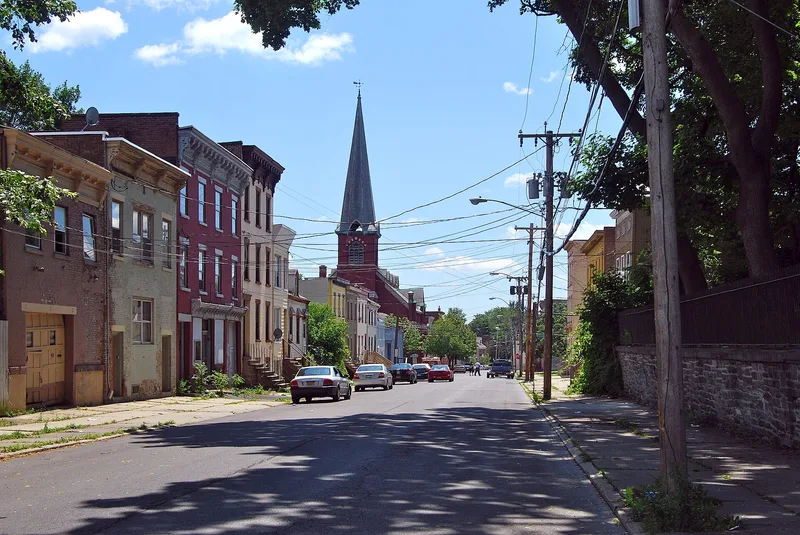
Albany's South End-Groesbeckville district covers roughly 26 blocks south of downtown, a few blocks west of the Hudson River. It contains 507 contributing buildings and only 13 intrusions. Most are two- and three-story rowhouses of wood or brick, built mainly between the 1840s and 1870s, in vernacular versions of Greek Revival, Italianate and Eastlake design. Narrow, curving streets, some still paved in granite or brick, reflect two street grids that meet at an angle. The neighborhood grew after the 1804 subdivision of General Philip Schuyler's property, and the 1761 Schuyler Mansion remains its most distinguished building. Because most houses were financed by individual owners rather than speculators, styles and materials vary from lot to lot, yet the streetscapes stay consistent in scale and rhythm. South Pearl Street serves as the commercial spine. Gothic Revival churches, schools, an engine house, a bath house and a library add civic character to a community where residents lived, worked, shopped and worshiped within walking distance.
Machine-generated summary. This summary was generated by a language model from the official nomination document and has not been reviewed line by line by an editor. It may contain errors. Check the source document before relying on any detail. Source: nomination document (PDF) · catalog entry. Generated October 2026 (model claude-sonnet-5-5, prompt v1.0-2026-10-29).
| Styles | Vernacular adaptations of Greek Revival, Italianate and Eastlake, with Gothic Revival, Queen Anne, Arts and Crafts, Colonial Revival and Georgian Revival influences |
|---|---|
| Areas of significance | Exploration/Settlement, Architecture |
| Acreage | 57 |
| Boundary source | NPS cultural-resource GIS polygon |
| Full listing page | South End-Groesbeckville Historic District (property record) |
What listing means for this property
This is a historic district. Buildings within its boundary are either contributing (they add to the district's significance) or non-contributing. Owners of contributing income-producing buildings can claim the 20% federal rehabilitation tax credit; homeowners should look at state credits. National Register districts impose no design review by themselves; a local historic district ordinance, if one exists, does (the difference explained).
General information, not legal or tax advice. Rules change; confirm with your State Historic Preservation Office or a qualified adviser.