Sleepy Hollow Cemetery

The National Park Service has not published a boundary polygon for this district; the map shows the listed properties inside it and the district's reference point.
Why it's listed
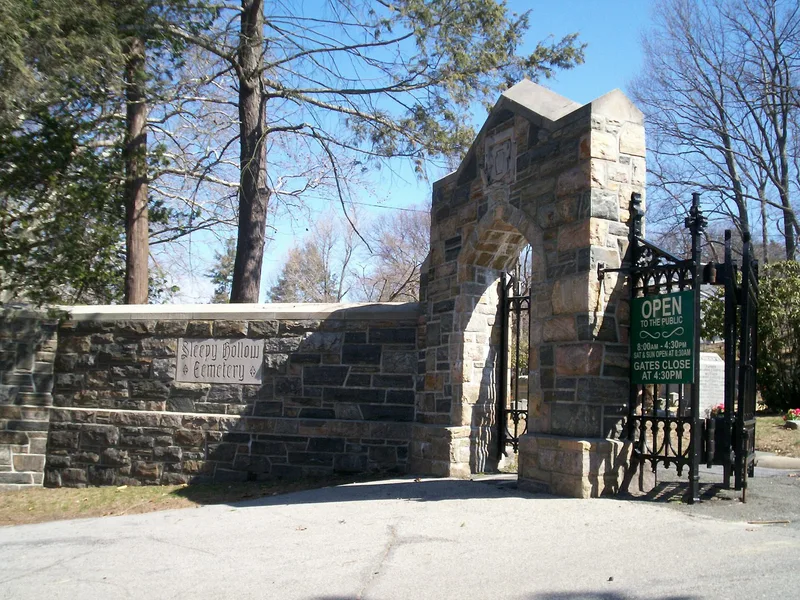
Sleepy Hollow Cemetery is a rural-style burial ground of about 85 acres in the village of Sleepy Hollow, New York, with winding drives, wooded hills, part of the Pocantico River and long views toward the Hudson. It was founded in 1849 as the Tarrytown Cemetery, an idea of Washington Irving and Captain Jacob Storm, and took its present name in 1865. Additional land was added in 1886 and 1890. The grounds hold roughly 45,000 burials and about 100 family mausoleums, along with monuments, a Collegiate Gothic chapel and gate from 1922-23, and works by architects and sculptors such as Richard Morris Hunt, Karl Bitter, Augustus Saint-Gaudens and Grosvenor Atterbury. The cemetery was recognized for its landscape design, architecture and funerary art, reflecting the rural cemetery movement. Its period of significance runs from 1849 to 1953, when the Lasker Mausoleum, the last major mausoleum, was built. The cemetery remains active today.
Machine-generated summary. This summary was generated by a language model from the official nomination document and has not been reviewed line by line by an editor. It may contain errors. Check the source document before relying on any detail. Source: nomination document (PDF) · catalog entry. Generated October 2026 (model claude-sonnet-5-5, prompt v1.0-2026-10-29).
| Period of significance | 1849-1953 |
|---|---|
| Styles | NO STYLE |
| Areas of significance | Architecture, Landscape Architecture, Other |
| Acreage | 85 |
| Boundary source | not published |
| Full listing page | Sleepy Hollow Cemetery (property record) |
What listing means for this property
This is a historic district. Buildings within its boundary are either contributing (they add to the district's significance) or non-contributing. Owners of contributing income-producing buildings can claim the 20% federal rehabilitation tax credit; homeowners should look at state credits. National Register districts impose no design review by themselves; a local historic district ordinance, if one exists, does (the difference explained).
General information, not legal or tax advice. Rules change; confirm with your State Historic Preservation Office or a qualified adviser.