Sisters of St. Dominic Motherhouse Complex

The National Park Service has not published a boundary polygon for this district; the map shows the listed properties inside it and the district's reference point.
Why it's listed
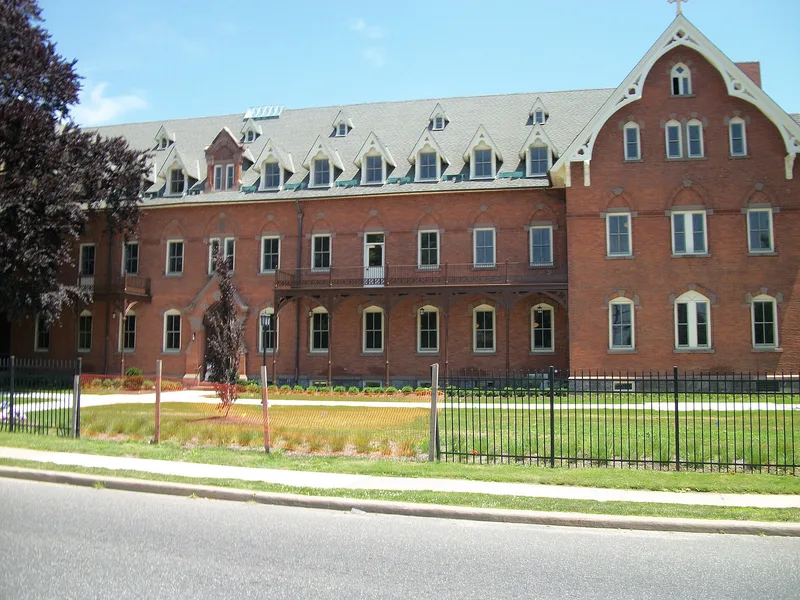
The Sisters of St. Dominic Motherhouse Complex occupies roughly ten historic acres on Albany Avenue in North Amityville. Its core is Rosary Hall, a brick Gothic Revival quadrangle built in 1876-1878 around a cloister garden, with a chapel and steeple at the northwest corner. Architect William Schickel designed it. Other contributing resources include Seraphina Cottage (ca. 1850), a vernacular Greek Revival farmhouse that served as the first novitiate; a six-sided brick potato house from 1888; a boiler house from about 1890; the Carpenter Gothic St. Dominic's Chapel of 1888, moved to its present site in 1905; a grotto; and a cemetery established in 1878 with more than 1,400 graves. The Dominican sisters arrived from Germany in 1853, taught in Brooklyn, and moved to North Amityville in 1875-76 after land was donated and purchased. They ran an orphanage, a working farm until 1934, and later a girls' academy. The complex remains a convent and chapel.
Machine-generated summary. This summary was generated by a language model from the official nomination document and has not been reviewed line by line by an editor. It may contain errors. Check the source document before relying on any detail. Source: nomination document (PDF) · catalog entry. Generated October 2026 (model claude-sonnet-5-5, prompt v1.0-2026-10-29).
| Styles | Greek Revival, Gothic Revival |
|---|---|
| Areas of significance | Religion, Social History, Architecture |
| Acreage | 9.6 |
| Boundary source | not published |
| Full listing page | Sisters of St. Dominic Motherhouse Complex (property record) |
What listing means for this property
This is a historic district. Buildings within its boundary are either contributing (they add to the district's significance) or non-contributing. Owners of contributing income-producing buildings can claim the 20% federal rehabilitation tax credit; homeowners should look at state credits. National Register districts impose no design review by themselves; a local historic district ordinance, if one exists, does (the difference explained).
General information, not legal or tax advice. Rules change; confirm with your State Historic Preservation Office or a qualified adviser.