Sailors' Snug Harbor National Register District

Why it's listed
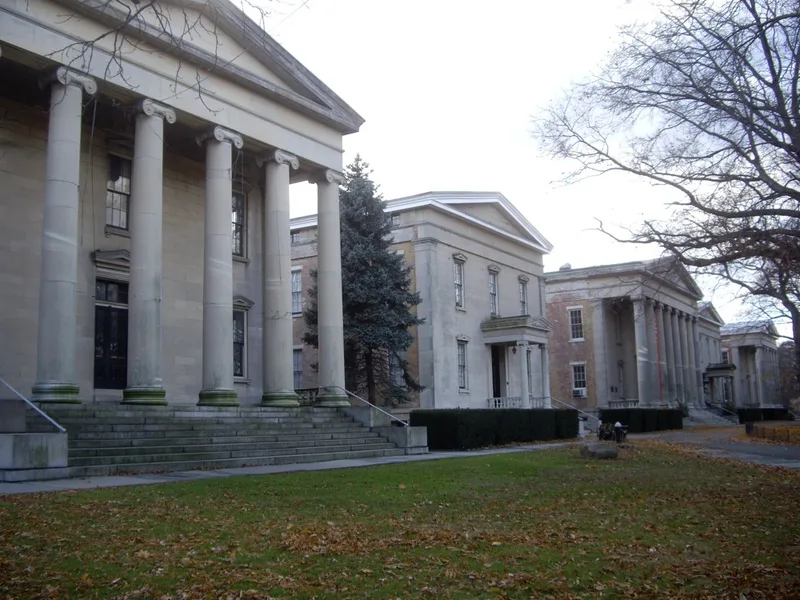
Sailors' Snug Harbor is a complex on Richmond Terrace in New Brighton, Staten Island, established as a home for retired seamen under the will of Captain Robert R. Randall. Its centerpiece is a row of five parallel Greek Revival buildings joined by a one-story corridor. The Administration Building, designed by Martin E. Thompson, was built in 1831-33 and set the style for the others, which followed between 1839 and 1880. Many architectural historians regard the group as the finest Greek Revival ensemble in the country. Other features include a trapezoidal gatehouse mixing several 19th century styles, a chapel completed around 1857 that blends Greek Revival and Italianate details, and a third-of-a-mile wrought iron fence designed by Frederick Diaper and erected in 1842. The trustees' 1965 plan to raze four of the buildings prompted a lawsuit against New York City's landmark designation, which the Appellate Division upheld. In 1971 the City announced plans to acquire the buildings for the Staten Island Museum and other public uses.
Machine-generated summary. This summary was generated by a language model from the official nomination document and has not been reviewed line by line by an editor. It may contain errors. Check the source document before relying on any detail. Source: nomination document (PDF) · catalog entry. Generated October 2026 (model claude-sonnet-5-5, prompt v1.0-2026-10-29).
| Period of significance | 19th Century (individual buildings dated 1831-1880) |
|---|---|
| Styles | Greek Revival (main buildings and fence); gatehouse mixes Italianate, Romanesque Revival and Second Empire elements; chapel blends Greek Revival and Italianate |
| Areas of significance | Landscape Architecture, Architecture |
| Acreage | 85 |
| Boundary source | NPS cultural-resource GIS polygon |
| Full listing page | Sailors' Snug Harbor National Register District (property record) |
What listing means for this property
This is a historic district. Buildings within its boundary are either contributing (they add to the district's significance) or non-contributing. Owners of contributing income-producing buildings can claim the 20% federal rehabilitation tax credit; homeowners should look at state credits. National Register districts impose no design review by themselves; a local historic district ordinance, if one exists, does (the difference explained).
General information, not legal or tax advice. Rules change; confirm with your State Historic Preservation Office or a qualified adviser.