Rowhouses at 322-344 East 69th Street

The National Park Service has not published a boundary polygon for this district; the map shows the listed properties inside it and the district's reference point.
Why it's listed
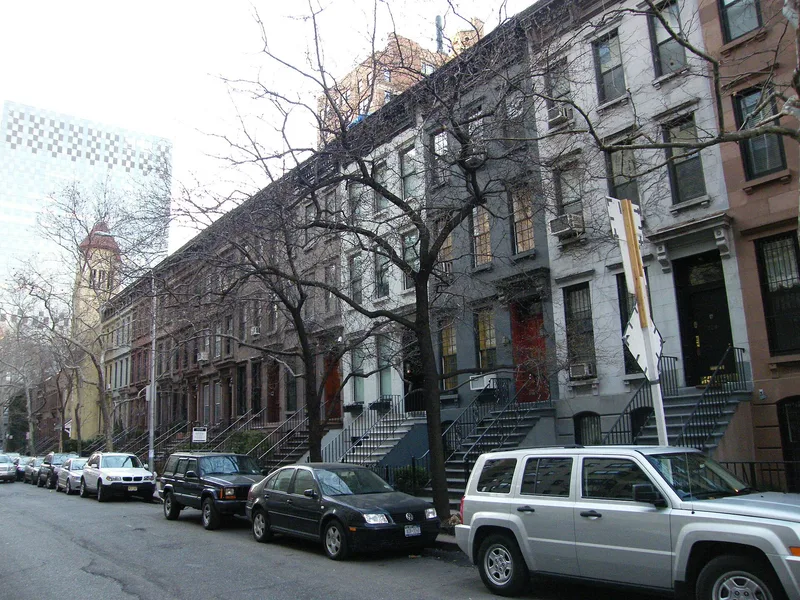
Twelve brownstone-fronted row houses on the south side of East 69th Street, between First and Second Avenues in Manhattan, make up this small group of single-family homes. Built in 1879-80 in the Neo-Grec style, each is three stories plus a basement, with a high stoop, double-doored entrance, rusticated base, segmental-arched windows and a galvanized-iron cornice with brackets. Jacob Valentine designed Nos. 322-332 and William R. Smith designed Nos. 334-344, both for speculative builder James E. Ray. The second row is somewhat more ornate, with fuller enframements around doors and windows. Construction boomed on the Upper East Side after the Third Avenue El opened in 1878, and most houses of the period were built by speculators for middle-class buyers. Few comparable Neo-Grec rows survive. These houses remain largely as built, apart from replaced railings, some later doors and windows, and one basement garage, and they stand among altered buildings and modern high-rises.
Machine-generated summary. This summary was generated by a language model from the official nomination document and has not been reviewed line by line by an editor. It may contain errors. Check the source document before relying on any detail. Source: nomination document (PDF) · catalog entry. Generated October 2026 (model claude-sonnet-5-5, prompt v1.0-2026-10-29).
| Period of significance | 1800-1899 (specific date 1879) |
|---|---|
| Styles | Neo-Grec |
| Areas of significance | Architecture |
| Acreage | 0.9 |
| Boundary source | not published |
| Full listing page | Rowhouses at 322-344 East 69th Street (property record) |
What listing means for this property
This is a historic district. Buildings within its boundary are either contributing (they add to the district's significance) or non-contributing. Owners of contributing income-producing buildings can claim the 20% federal rehabilitation tax credit; homeowners should look at state credits. National Register districts impose no design review by themselves; a local historic district ordinance, if one exists, does (the difference explained).
General information, not legal or tax advice. Rules change; confirm with your State Historic Preservation Office or a qualified adviser.