Rockland County Courthouse and Dutch Gardens

Why it's listed
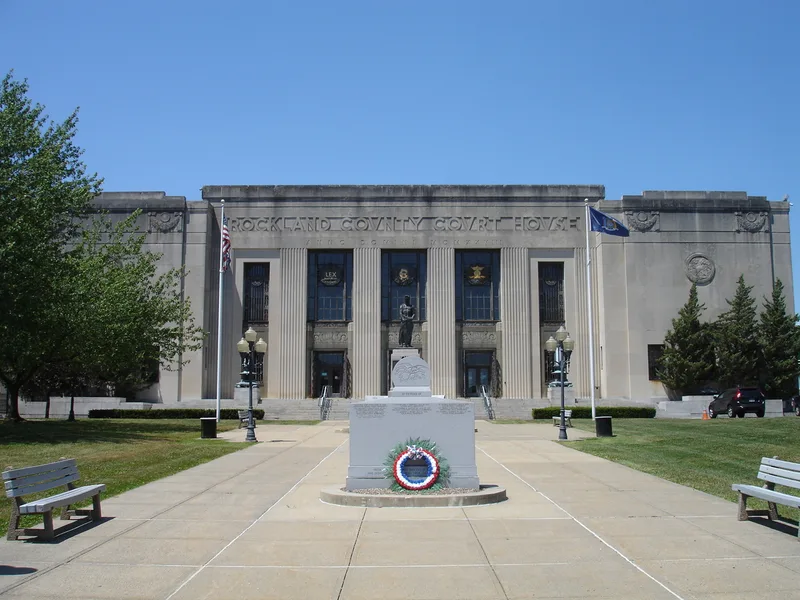
Rockland County Courthouse and Dutch Gardens form a civic complex in New City, New York. The three-story courthouse, finished in 1928, is faced in Indiana limestone and follows the Art Deco style, with a flat roof, a symmetrical plan, and carved seals, wrought-iron flowers and bronze doors. Inside, a marble stair rises beneath a 1929 painted map of the county. The design by Dennison and Hirons won a competition and replaced an earlier brick courthouse that the growing county had outgrown. Beside it, Dutch Gardens was built between 1934 and 1936 and was designed by Mary Mowbray Clarke. Formal flower beds, serpentine brick walls, a tea house, bandstand, arbor and gazebo evoke the county's Dutch settlement heritage, with brick carved by hand. Funded through the Works Progress Administration during the Depression, it is described as the only such project designed by a woman. Together the two properties are valued for their architecture and local history.
Machine-generated summary. This summary was generated by a language model from the official nomination document and has not been reviewed line by line by an editor. It may contain errors. Check the source document before relying on any detail. Source: nomination document (PDF) · catalog entry. Generated October 2026 (model claude-sonnet-5-5, prompt v1.0-2026-10-29).
| Period of significance | 1928; 1934-1936 |
|---|---|
| Styles | Modern Movement/Art Deco |
| Areas of significance | Landscape Architecture, Politics/Government, Architecture |
| Acreage | 7.8 |
| Boundary source | NPS cultural-resource GIS polygon |
| Full listing page | Rockland County Courthouse and Dutch Gardens (property record) |
What listing means for this property
This is a historic district. Buildings within its boundary are either contributing (they add to the district's significance) or non-contributing. Owners of contributing income-producing buildings can claim the 20% federal rehabilitation tax credit; homeowners should look at state credits. National Register districts impose no design review by themselves; a local historic district ordinance, if one exists, does (the difference explained).
General information, not legal or tax advice. Rules change; confirm with your State Historic Preservation Office or a qualified adviser.