Parkside West Historic District

Why it's listed
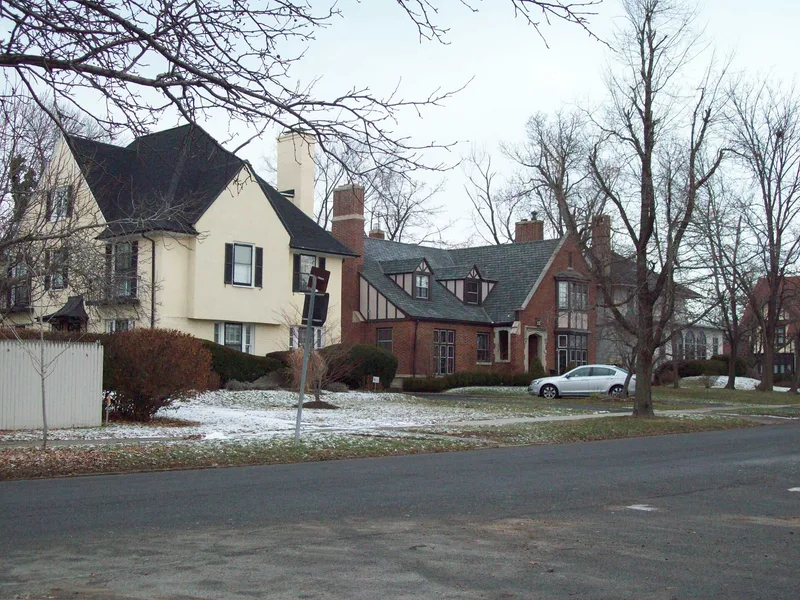
Parkside West is a crescent-shaped residential neighborhood of about 53 acres on the northwest edge of Delaware Park in Buffalo, about four miles north of downtown. Its curving streets follow the park edge and trace the western half of Frederick Law Olmsted's 1876 plan for the Parkside subdivision. Streets such as Nottingham Terrace, Middlesex Road, part of Lincoln Parkway and part of Delaware Avenue are counted as contributing structures. Although planned in 1876, building did not begin until 1923, and most lots were filled by 1940. Restrictive covenants on style and cost produced a cohesive group of expensive, mostly architect-designed brick, stone and stucco houses. Tudor Revival, Colonial Revival and French Chateau designs dominate, with a few manor houses in other styles. Buildings by Bley and Lyman, Shelgren and North, and Frederick Backus are among those described. The district retains a high level of integrity, with few alterations and cast-iron street lights surviving from the period.
Machine-generated summary. This summary was generated by a language model from the official nomination document and has not been reviewed line by line by an editor. It may contain errors. Check the source document before relying on any detail. Source: nomination document (PDF) · catalog entry. Generated October 2026 (model claude-sonnet-5-5, prompt v1.0-2026-10-29).
| Period of significance | 1876-1940 |
|---|---|
| Styles | Tudor Revival, Colonial Revival, French Chateau/French Eclectic, with some French Renaissance, Mission/Spanish Eclectic and Italian Renaissance |
| Areas of significance | Landscape Architecture, Architecture |
| Acreage | 53 |
| Boundary source | NPS cultural-resource GIS polygon |
| Full listing page | Parkside West Historic District (property record) |
What listing means for this property
This is a historic district. Buildings within its boundary are either contributing (they add to the district's significance) or non-contributing. Owners of contributing income-producing buildings can claim the 20% federal rehabilitation tax credit; homeowners should look at state credits. National Register districts impose no design review by themselves; a local historic district ordinance, if one exists, does (the difference explained).
General information, not legal or tax advice. Rules change; confirm with your State Historic Preservation Office or a qualified adviser.