Parkside East Historic District

Why it's listed
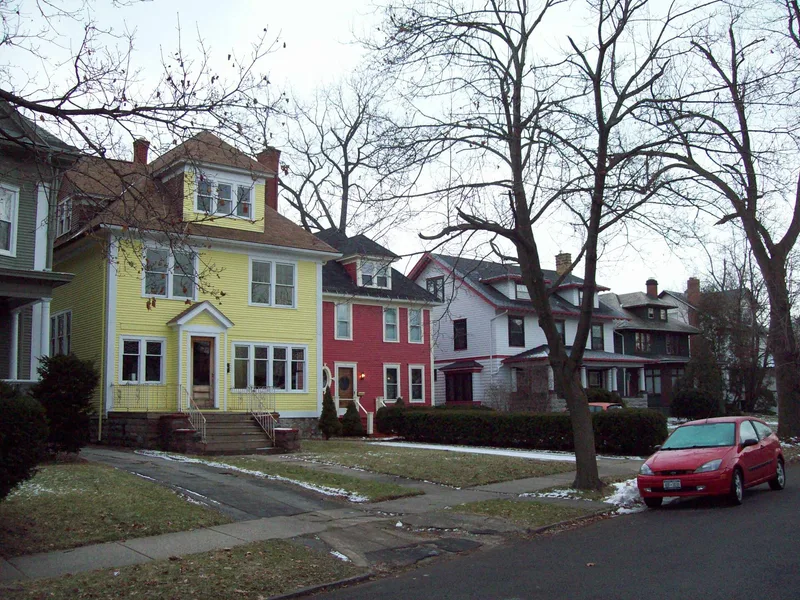
Parkside East is a neighborhood of about 226 acres curving around the east and northeast edges of Delaware Park in Buffalo, roughly four miles north of downtown. It was laid out from Frederick Law Olmsted's 1876 and c. 1886 plans for Parkside, a residential subdivision meant to extend the park and shield it from incompatible development. Informal curving streets, Medina sandstone curbs, grass parking strips and mature trees give the streetscapes their character. The district holds 1,109 contributing principal buildings, mostly small wood-frame single-family houses built between 1888 and 1936. Narrow gabled houses and American four-squares predominate, with smaller numbers of Queen Anne, Shingle, Craftsman, Colonial Revival and Tudor Revival examples. Four Prairie style houses by Frank Lloyd Wright, including the Darwin Martin House, stand alongside Romanesque Revival and English Gothic church complexes. Its high level of original integrity and its link to Olmsted's design for the park edge are the main reasons for its recognition.
Machine-generated summary. This summary was generated by a language model from the official nomination document and has not been reviewed line by line by an editor. It may contain errors. Check the source document before relying on any detail. Source: nomination document (PDF) · catalog entry. Generated October 2026 (model claude-sonnet-5-5, prompt v1.0-2026-10-29).
| Period of significance | 1876-1936 |
|---|---|
| Styles | Late Victorian gabled houses, American four-square, Queen Anne, Shingle, Craftsman, Colonial Revival, Tudor Revival, Spanish Colonial Revival, Prairie style |
| Areas of significance | Community Planning and Development, Landscape Architecture, Architecture |
| Acreage | 226 |
| Boundary source | NPS cultural-resource GIS polygon |
| Full listing page | Parkside East Historic District (property record) |
What listing means for this property
This is a historic district. Buildings within its boundary are either contributing (they add to the district's significance) or non-contributing. Owners of contributing income-producing buildings can claim the 20% federal rehabilitation tax credit; homeowners should look at state credits. National Register districts impose no design review by themselves; a local historic district ordinance, if one exists, does (the difference explained).
General information, not legal or tax advice. Rules change; confirm with your State Historic Preservation Office or a qualified adviser.